Plant profile
Silver vase plant
Aechmea fasciata
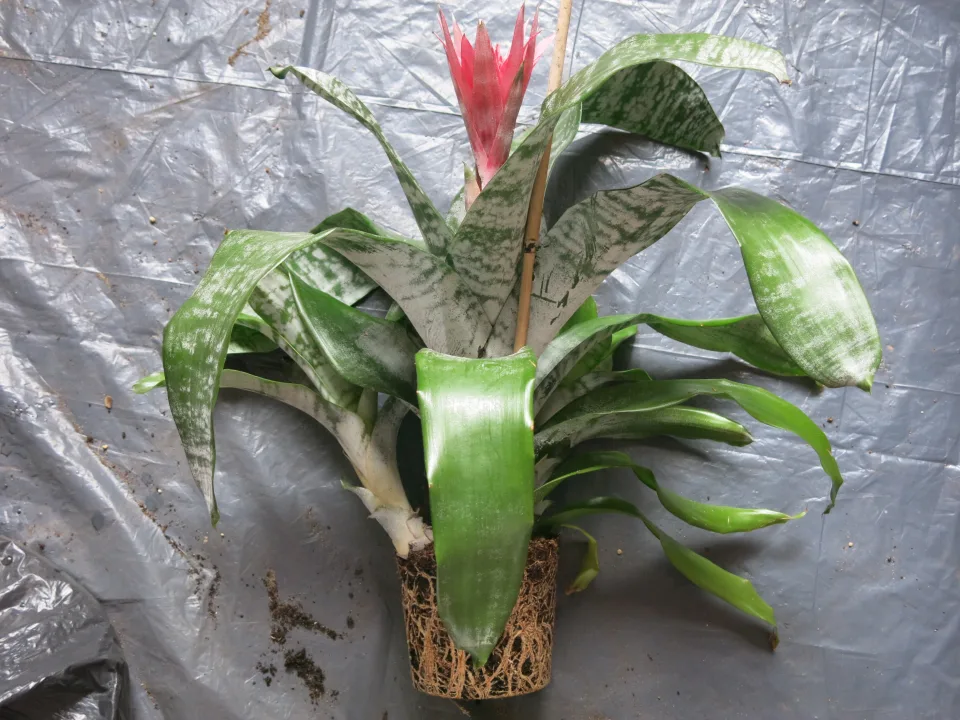
Photo : Tangopaso — Public domain — source

🌱 Growing conditions
☀️ Light
Bright indirect light; some gentle sun is acceptable.
💧 Watering
Keep the mix only lightly moist. In warm conditions a little soft water may be kept in the central cup and replaced regularly.
🌡️ Temperature
18–27 °C
💦 Humidity
Average to high
🪴 Potting mix
Very airy and free-draining, rich in bark or coarse fibre.
⭐ Difficulty
Easy to moderate
🌱 Growth
Slow
📏 Mature size
40–70 cm
🌿 Habit
Rosette
📝 About Silver vase plant
Description
A striking bromeliad with broad grey-green leaves forming a vase-shaped rosette and marked with silvery bands. The pink bracts can remain decorative for months. Each rosette flowers only once, then slowly declines while producing offsets.
Each rosette flowers only once. The coloured bracts can remain decorative for a long time, but after flowering the mother rosette declines slowly while producing offsets at the base. This gradual ageing is normal and should not be mistaken for sudden plant failure.
Care
Give bright filtered light. Prefer soft water; in warm weather a small amount may remain in the central cup, but refresh it regularly. Keep the potting mix only lightly moist and never waterlogged.
Use low-mineral water if possible. In warm conditions a small amount of fresh water can be kept in the central cup, but it should be emptied and renewed regularly; in cooler conditions the centre should remain drier. The potting mix itself should stay only lightly moist and very airy. Bright filtered light helps maintain colour without scorching the leaves.
Repotting
Repotting is rarely needed. Use a small stable pot with drainage holes and a very airy bromeliad mix. After flowering, allow offsets to develop before separating them.
The root system is relatively small, so a compact, stable pot is enough. Repot only when the mix has degraded or offsets have crowded the container, using a very airy bromeliad mix rather than dense compost.
Propagation
Separate offsets when they are roughly one-third to one-half the size of the mother rosette and have begun to form roots.
Separate offsets once they have reached roughly one third to one half of the mother rosette's size and have begun to form their own roots, or leave them together for a fuller clump.
🐱 Toxicity
Generally considered of low toxicity, although the leaf margins may have small spines that can cause mechanical irritation.
🩺 Common problems
Yellow leaves
Gradual yellowing of the mother rosette after flowering is normal. Rapid yellowing of a young plant suggests excess moisture, cold or stagnant water in the centre.
Brown leaves
Very dry air, mineral-rich water or strong direct sun can cause brown tips or patches.
Diseases
Crown and root rot can develop if water stagnates for long periods, especially in cool conditions.
Pests
Scale insects and mealybugs, often hidden deep between leaf bases. Check leaf axils and the base of the rosette, where scale insects can remain hidden. Remove colonies without letting treatment solution or water sit in the crown for long.