Plant profile
Lipstick plant
Aeschynanthus radicans
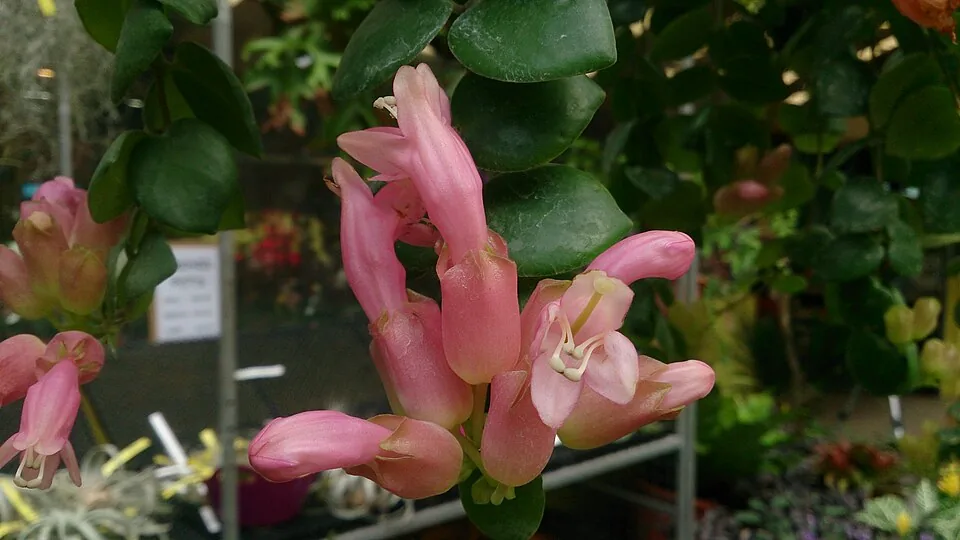
Photo : Mokkie — CC BY-SA 3.0 — source

🌱 Growing conditions
☀️ Light
Bright indirect light.
💧 Watering
Water after partial drying of the growing medium and let it drain completely.
🌡️ Temperature
18 to 28 °C
💦 Humidity
Medium to high
🪴 Potting mix
Very airy, with bark and draining components.
⭐ Difficulty
Moderate
🌱 Growth
Moderate
📏 Mature size
trailing stems 60 cm to 1.5 m
🌿 Habit
trailing
📝 About Lipstick plant
Description
Aeschynanthus radicans is a tropical epiphyte with long flexible stems and thick, glossy leaves. Its red tubular flowers emerge from dark calyces near the tips of the shoots, giving rise to the common name “lipstick plant”. In a hanging pot it naturally develops a dense cascading habit.
Care
Bright indirect light. Water after partial drying of the medium and allow it to drain completely. Above all, avoid abrupt changes in conditions and check the root ball before watering again.
To encourage flowering, allow the stems to lengthen instead of trimming them repeatedly and keep the plant very close to a bright window without harsh sun.
Repotting
Repot when roots truly fill the container or the medium has degraded. Choose a pot with drainage holes only slightly larger and use a very airy mix with bark and draining components. An unnecessarily large pot keeps moisture around the roots for longer.
Its epiphytic roots prefer a fairly snug pot and a coarse mix; a deep container packed with fine compost dries too slowly.
Propagation
Take stem segments carrying several nodes and root them in a very airy, warm, slightly moist medium.
Preferably take a shoot tip with several nodes; removing the leaves from the buried node reduces the risk of rot while it roots.
🐱 Toxicity
Considered non-toxic to dogs and cats. Aeschynanthus sold as lipstick plants are listed among non-toxic plants by the ASPCA.
🩺 Common problems
Yellow leaves
If several leaves of Aeschynanthus radicans yellow together, first check the moisture of the medium, then light and temperature. A single old leaf may simply be reaching the end of its cycle.
Brown leaves
On Aeschynanthus radicans, distinguish a dry tip from a soft area: the first often accompanies drying or overly strong sun, while the second points more toward excess moisture.
Diseases
Root problems in Aeschynanthus radicans become more likely in constantly wet, poorly aerated medium. Rapid loss of vigor or a soft base justifies checking the roots.
Pests
Inspect leaf undersides, nodes and young shoots of Aeschynanthus radicans. If you see stippling, distortion, cottony masses or visible insects, isolate the plant before treating.