Plant profile
Aglaonema Silver Bay
Aglaonema 'Silver Bay'
🌱 Growing conditions
☀️ Light
Low to bright indirect light; medium light gives denser growth.
💧 Watering
Allow the top 3–5 cm to dry before watering.
🌡️ Temperature
18–28 °C; protect from cold drafts.
💦 Humidity
Medium.
🪴 Potting mix
Light, rich and well-drained.
⭐ Difficulty
Easy
🌱 Growth
Slow to moderate
📏 Mature size
60–90 cm
🌿 Habit
Compact and upright
📝 About Aglaonema Silver Bay
Description
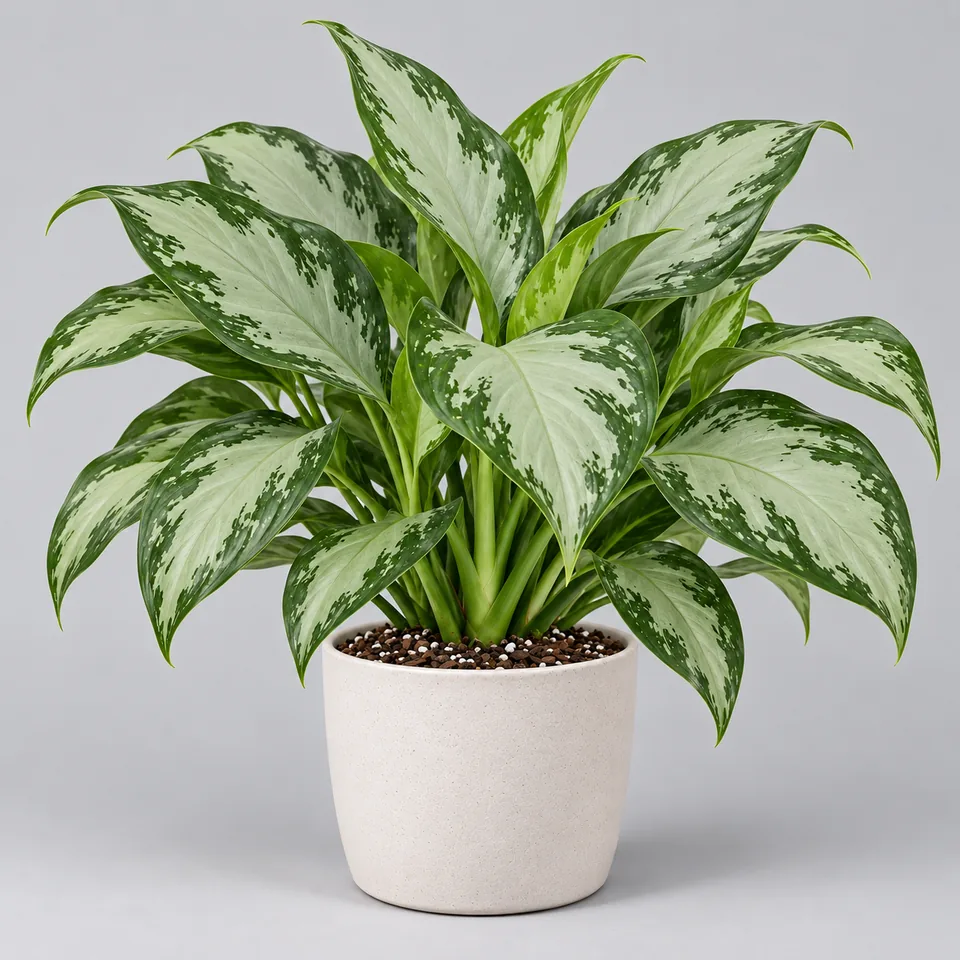
Aglaonema 'Silver Bay' forms broad green leaves with a large silvery central area. It is one of the Aglaonema cultivars most tolerant of ordinary indoor conditions and maintains a dense habit without requiring exceptionally bright light.
It tolerates low light, but that does not mean it prefers darkness. Medium indirect light promotes more regular growth and also allows the potting mix to dry at a safer rate.
Its fleshy stems and roots cope poorly with a growing medium that remains continuously saturated.
Care
Place it in a bright room without strong direct sun. It can live farther from a window, but it will grow more slowly.
Water when the upper part of the mix is dry and adapt the frequency strongly to the season. In low light, the pot can take much longer to dry.
Avoid low temperatures and drafts. Wipe the leaves when they become dusty.
Repotting
Repot when the roots are crowded, using a slightly larger pot and a well-draining mix. It tolerates being somewhat root-bound quite well.
Propagation
Propagate by dividing clumps or by stem cuttings. Sections of stem can produce new shoots when kept warm with moderate humidity.
🐱 Toxicity
Toxic if ingested because the tissues contain irritating calcium oxalate crystals.
🩺 Common problems
Yellow leaves
Very often caused by excess water, especially in low light. An old lower leaf may yellow naturally.
Brown leaves
Very dry air, mineral-rich water or direct sun. Soft areas at the base point toward excess moisture.
Diseases
Root and crown rot in potting mix that remains constantly wet.
Pests
Scale insects, spider mites and thrips. Inspect newly unfurling leaves, petioles and leaf undersides especially: silvery scars and distortion suggest thrips, fine stippling suggests mites, and fixed clusters or scales indicate scale insects.