Plant profile
Red Secret alocasia
Alocasia cuprea 'Red Secret'
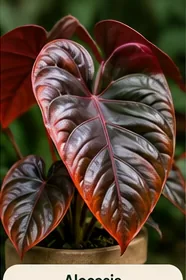
Photo : PlantMinute — Image générée
🌱 Growing conditions
☀️ Light
Bright indirect light
💧 Watering
Keep lightly moist during active growth without standing water; reduce watering if growth slows
🌡️ Temperature
20 to 28 °C
💦 Humidity
High, ideally 60% or more
🪴 Potting mix
Very airy, chunky and well-draining
⭐ Difficulty
Moderate to demanding
🌱 Growth
Slow to moderate
📏 Mature size
40 to 70 cm
🌿 Habit
compact and upright
📝 About Red Secret alocasia
Description
Alocasia cuprea ‘Red Secret’ is sought after for very thick, almost metallic leaves with deeply impressed veins. Young leaves can show copper, dark red or purple reflections before becoming more bronze-green.
The plant stays relatively compact but needs more consistent conditions than a pothos or common philodendron. Its roots need oxygen while the foliage benefits from a warm, humid atmosphere.
It can slow down dramatically in winter. When that happens, watering should be reduced rather than trying to force growth.
Care
Place it in bright filtered light without scorching direct sun. Stable warmth and high humidity help prevent dry edges and help new leaves unfurl properly.
Water when the surface begins to dry but before the whole root ball becomes dry. The mix must remain airy and never waterlogged.
Avoid leaving water in the center between the petioles. Good ventilation matters whenever humidity is high.
Feed weakly during active growth and stop or greatly reduce feeding when growth slows.
Repotting
Repot in spring when roots fill the container, using a pot with drainage holes only slightly larger. Alocasia plants do poorly in large volumes of wet soil.
Use a chunky mix of bark, coir, perlite or pumice and some light organic matter. Keep the corm at about the same depth as before.
Propagation
Separate offsets or small corms during repotting. Corms can be started in sphagnum moss, moist perlite or a very light warm mix until roots and a leaf appear.
Leaf cuttings do not work.
🐱 Toxicity
Toxic if swallowed because of calcium oxalate crystals.
🩺 Common problems
Yellow leaves
Rapid yellowing is often linked to roots that are too wet, cold conditions or a seasonal slowdown. An old leaf can also yellow while the plant directs resources into a new one.
Check the roots before increasing watering.
Brown leaves
Brown edges are common with dry air, hard or mineral-rich water or irregular watering. Direct sun creates dry, bleached patches.
Dark soft areas together with softened petioles point to excess water or early rot.
Diseases
Root and corm rot in saturated conditions; bacterial or fungal spots are encouraged by heat, high humidity and poor air circulation.
Pests
Very prone to spider mites; thrips and scale insects can also occur. Check leaf undersides and petioles especially: fine stippling with tiny webs often signals spider mites, while silvery streaks and distorted new leaves suggest thrips.