Plant profile
Alocasia Melo
Alocasia melo
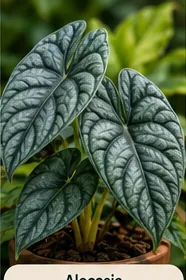
Photo : PlantMinute — Image générée
🌱 Growing conditions
☀️ Light
Bright indirect light; avoid intense direct sun.
💧 Watering
Let the surface dry before watering again; keep the roots well aerated.
🌡️ Temperature
20 to 28 °C
💦 Humidity
High
🪴 Potting mix
Very airy, mineral-rich and free-draining.
⭐ Difficulty
Demanding
🌱 Growth
Slow
📏 Mature size
30 to 50 cm
🌿 Habit
compact and upright
📝 About Alocasia Melo
Description
Alocasia melo is famous for its extremely thick, rigid and heavily bullate leaves, coloured grey-green to dark green. Their texture is almost stone-like, which clearly sets the species apart from most other Alocasias.
It grows slowly and remains compact. Its tough appearance does not mean it tolerates excess water: the corm and roots remain sensitive to a saturated mix.
It prefers a warm, humid environment, but with a very breathable root medium. This is one of the plants in which high air humidity and strong root-zone aeration need to go together.
Care
Keep it in bright, filtered light. Intense direct sun can permanently mark the thick leaves.
Water when the surface of the pot has begun to dry, then let it drain thoroughly. The mix should be moist after watering but regain air quickly.
Avoid repeatedly misting the leaves, as their texture can hold water. Instead, wipe them gently with a damp cloth. Feed sparingly and only during active growth.
Repotting
Repot only when the pot is well filled with roots or the mix has become compacted. Use a pot with drainage holes that is only slightly wider.
A very free-draining blend of bark, pumice, perlite and a light organic component is ideal.
Propagation
Separate small corms and offsets formed around the mother plant. The corms can be started warm in moist perlite or sphagnum.
Leaf propagation is not possible.
🐱 Toxicity
Toxic if ingested because of calcium oxalate crystals.
🩺 Common problems
Yellow leaves
General yellowing most often points to too much water, cold conditions or weakened roots. A single older yellow leaf can be normal.
Brown leaves
Edges may brown in dry air, after prolonged drought or with very hard water. Direct sun can create pale areas that later turn brown.
Diseases
Root and corm rot in saturated mix; leaf spotting if water remains on the foliage.
Pests
Spider mites in particular, followed by thrips and scale insects. Check leaf undersides and petioles especially: fine stippling with tiny webs often signals spider mites, while silvery streaks and distorted new leaves suggest thrips.