Plant profile
Regal anthurium
Anthurium regale
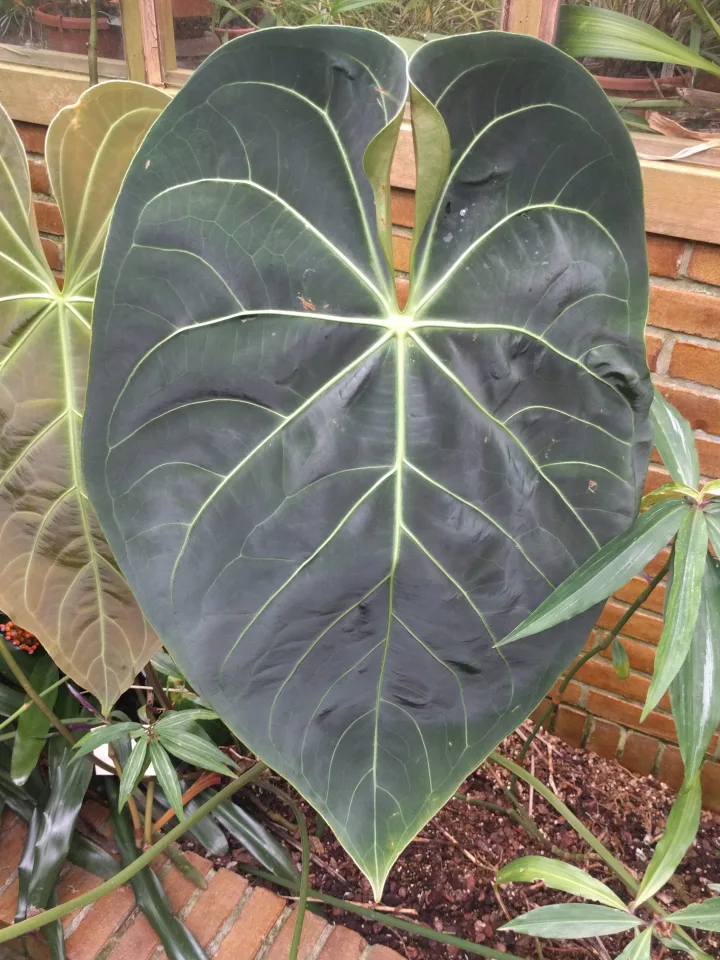
Photo : Rudolphous — CC BY-SA 4.0 — source

🌱 Growing conditions
☀️ Light
Bright indirect light, without hot direct sun.
💧 Watering
Keep the mix lightly moist, allowing the surface to dry slightly between waterings. Never leave standing water in the pot or saucer.
🌡️ Temperature
20–28 °C. Avoid prolonged temperatures below 18 °C.
💦 Humidity
High, ideally 60% or more with gentle air movement.
🪴 Potting mix
Very airy and coarse, rich in bark, fibres and free-draining material.
⭐ Difficulty
Demanding
🌱 Growth
Slow to moderate
📏 Mature size
60–120 cm indoors; leaves can approach or exceed 1 m in excellent conditions
🌿 Habit
Upright rosette
📝 About Regal anthurium
Description
One of the most spectacular foliage anthuriums, with very large velvety dark-green leaves crossed by pale veins. It needs more stable conditions than a common flowering anthurium, and expanding leaves are particularly sensitive to dry air, erratic watering and physical damage.
This foliage Anthurium is grown for its very large velvety leaves and contrasting pale veins. New leaves are especially fragile while expanding and can be permanently marked by low humidity, irregular watering or simple physical contact. High air humidity is useful, but it must not be confused with keeping the potting mix constantly wet.
Care
Provide bright filtered light, warmth, high humidity and gentle air movement. Water as the surface begins to dry, then allow all excess water to drain. Low-mineral water helps reduce deposits. Avoid moving or handling the plant while a new leaf is expanding.
Maintain warmth, high humidity and gentle air movement together. Give bright filtered light and water when the surface has begun to dry slightly, then let the pot drain completely. Low-mineral water helps limit deposits on the velvety foliage. Avoid moving or touching a new leaf while it is unfurling and hardening.
Repotting
Repot only when roots genuinely fill the container or the mix has broken down. Use a pot with drainage holes only slightly larger and a coarse aroid mix containing bark, perlite or pumice, coconut fibre and light organic matter.
Repot only when roots have genuinely filled the container or the mix has degraded. Use a pot only slightly larger than the root mass and a very coarse aroid mix with bark, mineral drainage material and light organic matter; dense conventional compost retains too much water around the roots.
Propagation
Large plants with several growing points or offsets can sometimes be divided, provided each section keeps healthy roots. Seed is possible from fresh berries but slow; leaf cuttings do not work.
Divide only plants with more than one growth point or well-rooted offsets, keeping healthy roots with each section. Fresh seed can also be used but is slow; leaf cuttings do not produce a new Anthurium regale.
🐱 Toxicity
Toxic if eaten. The tissues contain calcium oxalate crystals that can strongly irritate the mouth, mucous membranes and digestive tract.
🩺 Common problems
Yellow leaves
Rapid yellowing is often linked to roots that are too wet, chilling or a damaged root system. An older leaf may nevertheless yellow naturally when the plant redirects resources toward a new leaf.
Always check the condition of the roots before increasing watering.
Brown leaves
Brown margins commonly result from low humidity, irregular watering or mineral-rich water. Pale then brown patches may be sun damage, and tender new leaves can mark after rubbing or unfolding in dry air.
Diseases
Root rot and bacterial or fungal disease can develop when warmth, stagnant moisture and poor ventilation occur together.
A fermenting smell from the pot calls for an immediate root inspection.
Pests
Thrips, spider mites and scale insects; thrips are especially worth checking on newly unfurling leaves.