Plant profile
Begonia ferox
Begonia ferox
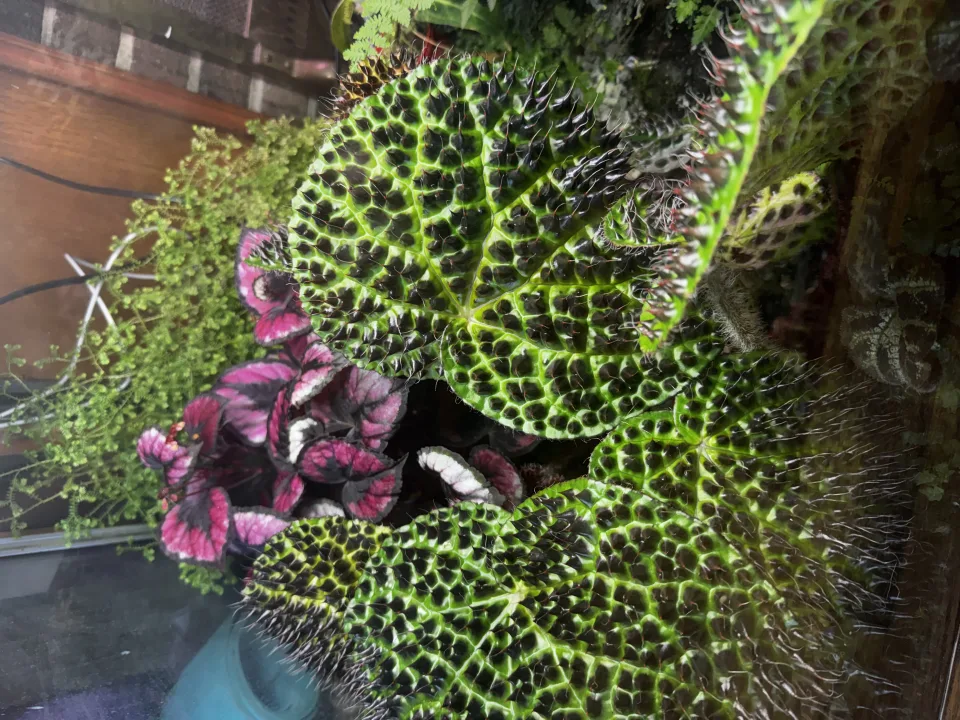
Photo : Theplantingbooth — CC BY 4.0 — source

🌱 Growing conditions
☀️ Light
Bright indirect to medium light; avoid strong direct sun.
💧 Watering
Let the surface dry slightly, then water without keeping the crown wet.
🌡️ Temperature
18 to 26 °C.
💦 Humidity
High, ideally 60% or more, with air movement.
🪴 Potting mix
Very airy: humus-rich mix with perlite or pumice and fine bark.
⭐ Difficulty
Difficult
🌱 Growth
Slow to moderate
📏 Mature size
20 to 35 cm
🌿 Habit
compact and rhizomatous
📝 About Begonia ferox
Description
Begonia ferox is famous for dark green leaves covered, at maturity, with striking black cone-like projections. Young leaves begin relatively smooth and the cones develop gradually, giving the plant its dramatic appearance.
This begonia needs more stability than a standard foliage plant: high humidity, steady warmth, filtered light and an extremely airy mix. Its fine roots dislike saturation.
Care
Grow it in a cabinet, indoor greenhouse or naturally humid room if household air is dry, but avoid a completely sealed box; gentle ventilation lowers fungal risk.
Water when the surface starts to dry. Low-mineral water is preferable, and repeated splashing on the leaves should be avoided.
Repotting
Repot carefully into a fairly wide, shallow pot. Do not bury the rhizome deeply and do not oversize the container.
Propagation
Propagate from leaf cuttings or rhizome pieces in warm, humid conditions. Young plantlets need steady humidity until established.
🐱 Toxicity
Like many Begonia, it contains soluble oxalates and can be toxic if ingested, especially to pets. Keep out of reach.
🩺 Common problems
Yellow leaves
Excess water, poor ventilation or root stress. Check rhizome and roots if several leaves yellow quickly.
Brown leaves
Low humidity, sunburn, mineral-rich water or temporary drought.
Diseases
Botrytis, leaf spots and rhizome rot when the air is stagnant and the mix is too wet.
Pests
Thrips, spider mites and mealybugs. Watch young leaves and their undersides especially: silvery scarring and distortion suggest thrips, fine stippling mites, and cottony clusters mealybugs.