Plant profile
Escargot Begonia
Begonia rex 'Escargot'
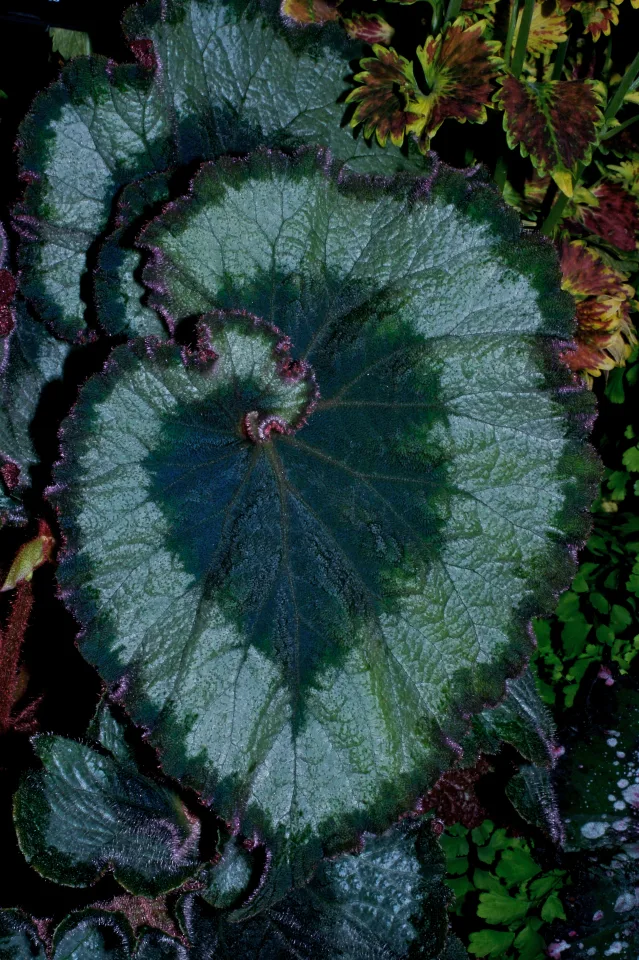
Photo : Photograph by Mike Peel (www.mikepeel.net). — CC BY-SA 4.0 — source

🌱 Growing conditions
☀️ Light
Bright indirect light; avoid direct sun.
💧 Watering
Allow the surface to dry slightly before watering; avoid excess water.
🌡️ Temperature
18 to 26 °C
💦 Humidity
Medium to high; provide good airflow
🪴 Potting mix
Light, humus-rich and well drained.
⭐ Difficulty
Moderate
🌱 Growth
Moderate
📏 Mature size
25 to 40 cm
🌿 Habit
compact and spreading
📝 About Escargot Begonia
Description
Begonia rex ‘Escargot’ is famous for its strongly spiralled pattern, which resembles a snail shell. The leaves combine green, silver and darker areas with a velvety texture.
It stays compact and is grown mainly for its foliage. Like many rex begonias, it appreciates decent ambient humidity but reacts poorly to leaves that remain continuously wet.
Its relatively fine root system needs a light mix and a pot that does not stay saturated after watering.
Care
Keep it in bright filtered light. Too much sun scorches the leaves, while insufficient light dulls the pattern.
Water when the surface has dried slightly. Avoid frequently wetting the foliage, especially in the evening. Good ambient humidity combined with moving air gives better results.
Remove damaged leaves at the base and feed lightly in spring and summer.
Repotting
Repot in spring when the roots fill the pot well. Rex begonias often prefer fairly shallow containers. A light mix of fine potting compost, perlite or pumice and coco fibre works well.
Propagation
Leaf cuttings are very effective with rex begonias. A healthy leaf can be cut into sections or laid on a lightly moist medium to produce young plants. Rhizome division is also possible.
🐱 Toxicity
Toxic if ingested, especially the underground parts; may irritate pets.
🩺 Common problems
Yellow leaves
Yellow, soft leaves often indicate too much water or a cold, wet mix. An old leaf may also yellow naturally.
Brown leaves
Dry margins are linked to dry air, an overly dry root ball or salt build-up. Brown spots in the centre can follow direct sun or persistent water droplets.
Diseases
Powdery mildew, Botrytis and crown rot in humid, stagnant air. If several leaves yellow or soften while the mix remains wet, check roots and crown. Remove black or mushy tissue, improve drainage and resume watering only after the mix starts to dry.
Pests
Spider mites, thrips, scale insects and sometimes whiteflies.