Plant profile
Lemon Lime Dracaena
Dracaena fragrans 'Lemon Lime'
🌱 Growing conditions
☀️ Light
Medium to bright indirect light; good light preserves variegation.
💧 Watering
Let the top 3–5 cm dry before watering again.
🌡️ Temperature
18–27 °C; avoid prolonged temperatures below 15 °C.
💦 Humidity
Average.
🪴 Potting mix
Light, airy and free-draining.
⭐ Difficulty
Easy
🌱 Growth
Slow to moderate
📏 Mature size
1–1.5 m indoors
🌿 Habit
upright bushy canes
📝 About Lemon Lime Dracaena
Description
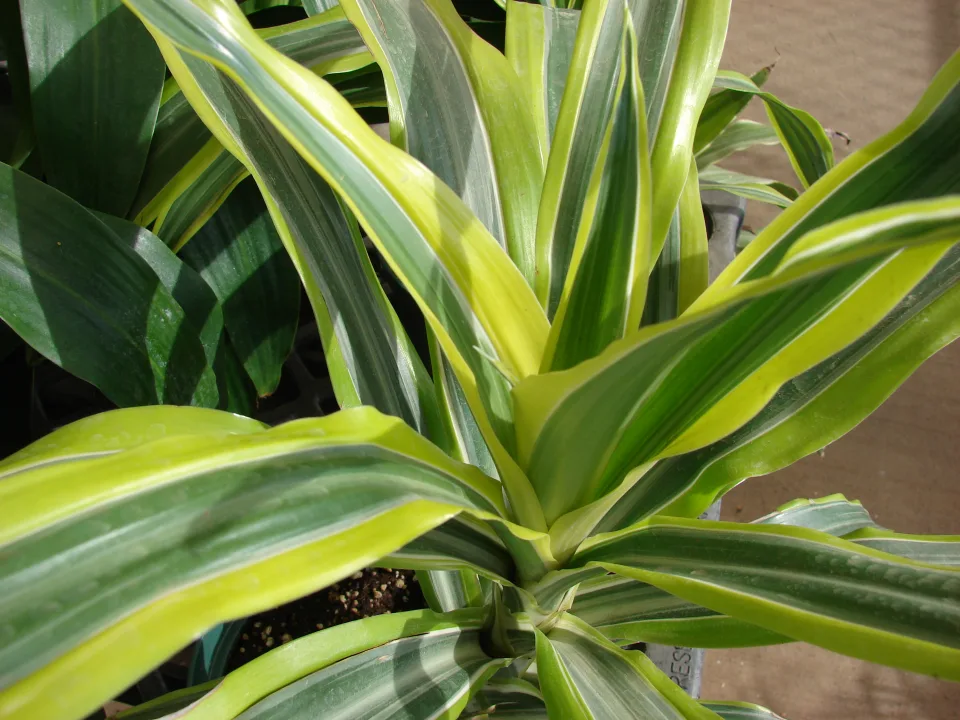
Cultivar with long strap-like leaves striped dark green, lime and creamy yellow; good light keeps the variegation clearer.
It grows slowly on stems or canes that store reserves. It copes better with a short delay in watering than with continuously wet mix.
Low light slows growth and reduces variegation contrast; strong direct sun can scorch pale areas.
Care
Keep it in medium to bright indirect light. Let several centimetres of mix dry, water thoroughly and empty the saucer. Water less often in winter.
Clean the leaves and feed very lightly during growth. Avoid strong fertilizer doses, which increase salt buildup and brown tips.
Repotting
Repot when roots genuinely fill the pot or the mix has compacted. A pot only 2–4 cm wider is enough.
Large specimens can be top-dressed in years when a full repot is unnecessary.
Propagation
Propagate from tip cuttings or cane sections. Keep them warm in bright indirect light in a light, only slightly moist mix.
After a stem is cut, the remaining cane can produce new shoots below the cut, so pruning can also improve branching.
🐱 Toxicity
Toxic to dogs and cats if ingested.
🩺 Common problems
Yellow leaves
Several yellow leaves with still-wet mix usually mean overwatering. One old lower leaf yellowing alone can be normal.
If variegation fades and growth becomes weak, gradually increase indirect light.
Brown leaves
Dry tips are often linked to mineral-rich water, salt buildup, dry air or irregular watering. Occasionally flush the mix thoroughly and let it drain.
Soft dark-brown areas at the leaf base fit excess moisture better than simple dry air.
Diseases
Root or cane rot occurs when the mix stays wet continuously. A soft or foul-smelling cane should be cut back to healthy tissue.
Risk rises when excess water is combined with low temperature.
Pests
Scale/mealybugs, spider mites and thrips. Inspect leaf axils, undersides and tight young rosettes.
Cottony clusters or honeydew point to mealybugs/scale; fine dry stippling often points to mites.