Plant profile
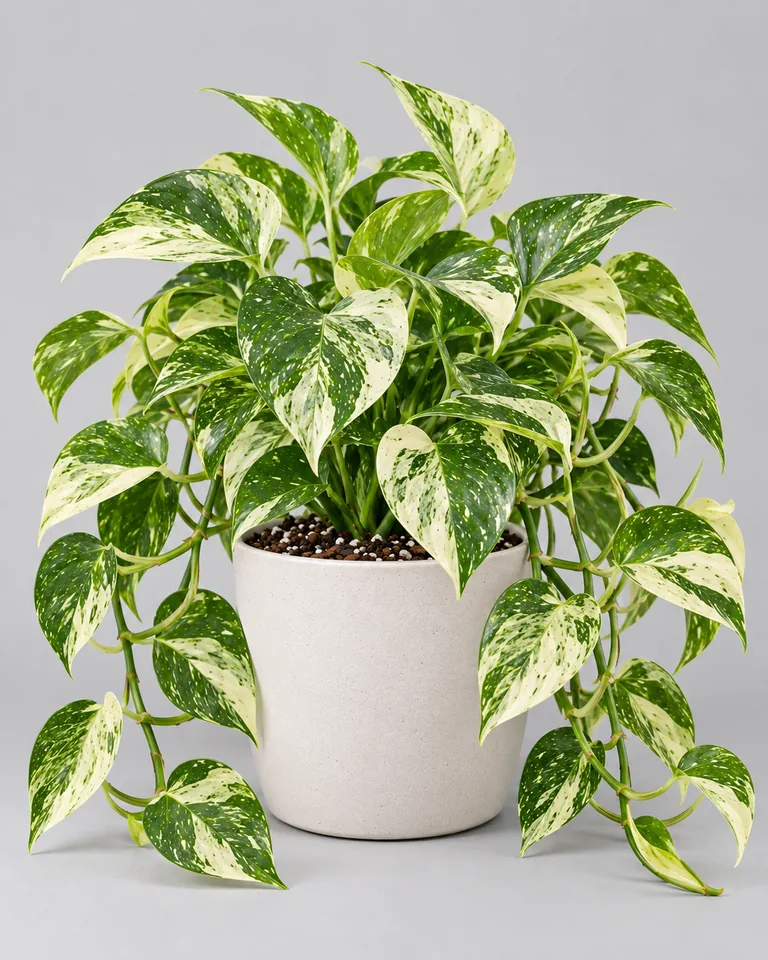
Pothos Marble Queen
Epipremnum aureum 'Marble Queen'
🌱 Growing conditions
☀️ Light
Medium to bright indirect light; variegated forms benefit from the brighter end of the range.
💧 Watering
Water after the top 3–5 cm are dry and let excess water escape.
🌡️ Temperature
18–28 °C.
💦 Humidity
Medium.
🪴 Potting mix
Light, airy and well-drained.
⭐ Difficulty
Easy to moderate
🌱 Growth
Moderate
📏 Mature size
1–3 m indoors depending on training
🌿 Habit
Climbing or trailing
📝 About Pothos Marble Queen
Description
Pothos 'Marble Queen' carries fine cream-and-green marbling that can become so extensive that some leaves appear almost white. Because the pale areas contain less chlorophyll, this cultivar normally grows more slowly than the standard golden pothos.
It can be grown in a hanging pot, allowed to trail from a shelf, or trained upward on a support. When it climbs in sufficiently bright conditions, the leaves can gradually increase in size.
Its main cultivar-specific requirement is light. In a position that is too dark, growth slows markedly and the contrast of the foliage becomes less pronounced.
Care
Place it in generous indirect light. Gentle sun can be tolerated after acclimation, but the cream-colored areas scorch faster than the green ones.
Water when the top layer of the mix has dried and let it drain completely. It tolerates a slight delay in watering better than a constantly waterlogged root ball.
Prune overly long stems to make the pot denser, and train a few stems upward if you want larger leaves.
Repotting
Repot when the roots are filling the pot well, using a container only slightly larger. A mix of potting soil, bark and perlite works well.
Propagation
Very easy from stem cuttings containing at least one node. They root in water or directly in a light, airy potting mix.
🐱 Toxicity
Toxic if ingested because the tissues contain irritating calcium oxalate crystals.
🩺 Common problems
Yellow leaves
Several yellow, soft leaves are often caused by overwatering. A single lower leaf may simply be aging.
Brown leaves
Cream-colored areas dry out easily after strong sun, prolonged drought or salt accumulation.
Diseases
Root rot when the potting mix remains constantly wet.
Pests
Thrips, scale insects and spider mites. Inspect newly unfurling leaves, petioles and leaf undersides especially: silvery scars and distortion suggest thrips, fine stippling suggests mites, and fixed clusters or scales indicate scale insects.