Plant profile
Pothos N'Joy
Epipremnum aureum 'N'Joy'
🌱 Growing conditions
☀️ Light
Medium to bright indirect light; variegated forms benefit from the brighter end of the range.
💧 Watering
Water after the top 3–5 cm are dry and let excess water escape.
🌡️ Temperature
18–28 °C.
💦 Humidity
Medium.
🪴 Potting mix
Light, airy and well-drained.
⭐ Difficulty
Easy to moderate
🌱 Growth
Moderate
📏 Mature size
1–2 m of stem indoors
🌿 Habit
Climbing or trailing
📝 About Pothos N'Joy
Description
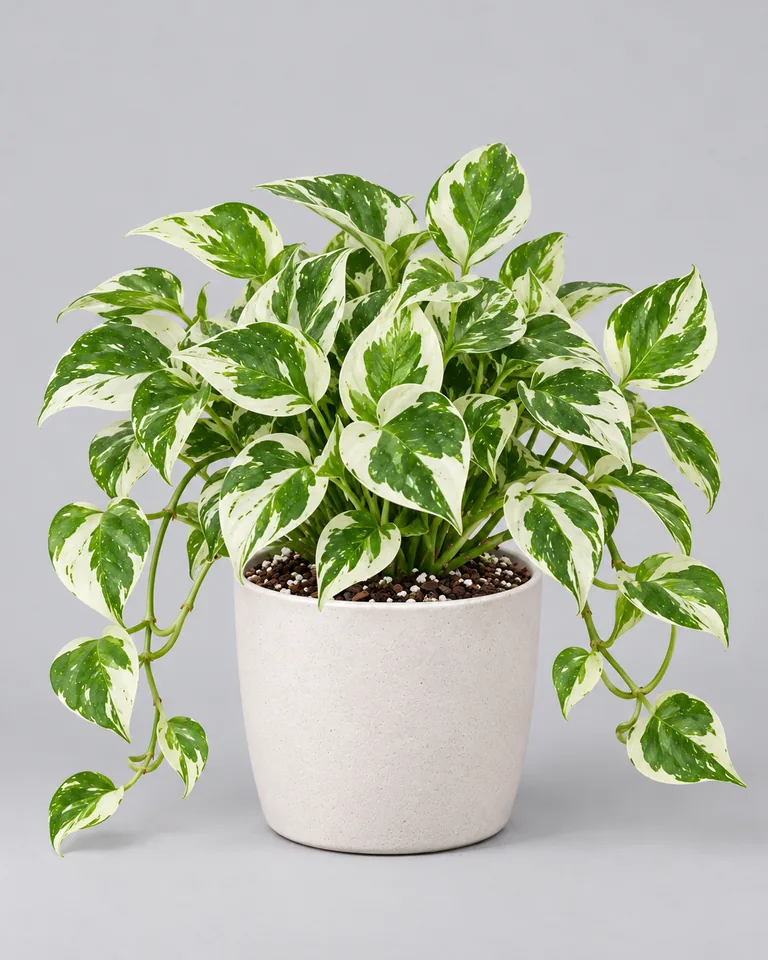
Pothos 'N'Joy' has relatively small leaves marked with sharply defined white or cream patches against a green background. It generally remains more compact than golden pothos and also grows somewhat more slowly.
The variegation reduces the photosynthetic surface, making light more important than it is for an all-green plant. In a dim position, growth slows and new leaves may emerge with a greater proportion of green.
Because its internodes stay fairly short when it receives enough light, it is especially well suited to small shelves, compact displays and hanging pots.
Care
Place it in bright, filtered light. Protect the white areas from intense direct sun.
Water only after the mix has partially dried and ensure rapid drainage. Rotate the pot from time to time to encourage even growth.
Repotting
Use a pot with drainage holes that is only slightly larger once the root ball is full. An airy mix helps limit the risk of overwatering.
Propagation
Take cuttings with a node. To obtain a full-looking pot, replant several cuttings around the mother plant.
🐱 Toxicity
Toxic if ingested because the tissues contain irritating calcium oxalate crystals.
🩺 Common problems
Yellow leaves
Often caused by overwatering or insufficient light. A single old leaf may yellow normally.
Brown leaves
White sectors brown more quickly in dry air, after direct sun exposure or when salts accumulate.
Diseases
Root rot in a mix that stays constantly wet.
Pests
Thrips, scale insects and spider mites. Inspect newly unfurling leaves, petioles and leaf undersides especially: silvery scars and distortion suggest thrips, fine stippling suggests mites, and fixed clusters or scales indicate scale insects.