Plant profile
Pothos Pearls and Jade
Epipremnum aureum 'Pearls and Jade'
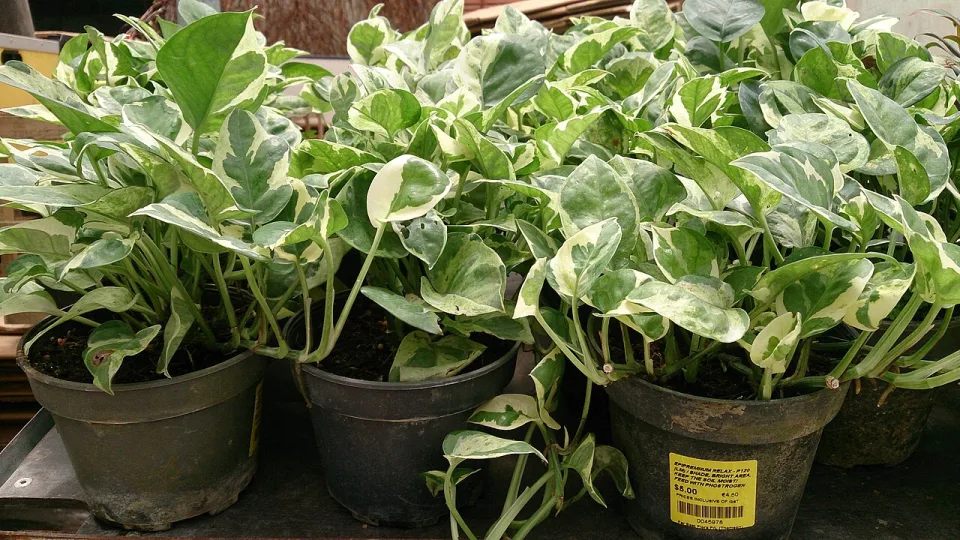
Photo : Mokkie — CC BY-SA 3.0 — source

🌱 Growing conditions
☀️ Light
Medium to bright indirect light; variegated forms benefit from the brighter end of the range.
💧 Watering
Water after the top 3–5 cm are dry and let excess water escape.
🌡️ Temperature
18–28 °C.
💦 Humidity
Medium.
🪴 Potting mix
Light, airy and well-drained.
⭐ Difficulty
Easy to moderate
🌱 Growth
Moderate
📏 Mature size
1–2 m of stem indoors
🌿 Habit
Climbing or trailing
📝 About Pothos Pearls and Jade
Description
Pothos 'Pearls and Jade' carries small green leaves variegated with white, cream and sometimes gray-green. Unlike 'N'Joy', the pale areas are often dotted with tiny green flecks, producing a finer, more irregular pattern.
It remains more compact and grows more slowly than standard golden pothos because a significant proportion of each leaf contains little chlorophyll. This moderate growth makes it particularly suitable for small shelves, desks and hanging pots.
In strong indirect light the pattern stays crisp. In a position that is too dark, the plant stretches between nodes and may produce greener leaves.
Care
Place it in bright but filtered light. The white areas scorch more easily than an entirely green leaf, so avoid sudden exposure to afternoon sun.
Always let the top of the pot dry between waterings. Empty the saucer or cachepot after watering. Pinch long stems if you want to keep a dense appearance, and replant the cuttings in the same pot.
A very diluted balanced fertilizer during the growing season is sufficient; overfertilizing can worsen browning on the white areas.
Repotting
Repot when the roots fill the container, using a pot only slightly larger. A mix of potting soil, bark and perlite works well; avoid oversized pots that dry too slowly.
Propagation
Take stem cuttings containing at least one node. They root easily in water or directly in a light potting mix. Grouping several cuttings together quickly rebuilds a dense clump.
🐱 Toxicity
Toxic if ingested because the tissues contain irritating calcium oxalate crystals.
🩺 Common problems
Yellow leaves
Most often caused by excess water, especially in low light. A single old lower leaf turning yellow can be normal.
Brown leaves
White areas brown easily after direct sun, prolonged drought, very dry air or mineral-salt buildup.
Diseases
Root rot when the potting mix stays wet for too long.
Pests
Thrips, scale insects, mealybugs and spider mites. Inspect leaf undersides, nodes and young growth regularly. Silvery scarring, fine stippling, sticky honeydew or cottony clusters often reveal an infestation before it spreads.