Plant profile
Golden pothos
Epipremnum aureum
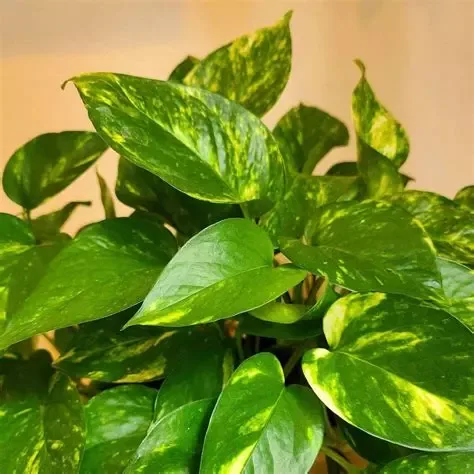
Photo : Sergei — Public domain — source

🌱 Growing conditions
☀️ Light
Medium to bright indirect light. It tolerates lower light, but growth slows, internodes lengthen and variegated forms lose some of their coloration. A little gentle morning or late-afternoon sun is possible after acclimation; avoid intense midday sun through glass.
💧 Watering
Water when the top 3–5 cm of the potting mix are dry, then soak the whole root ball and let excess water drain completely. Do not leave the pot standing in water. In winter or when light levels fall, water less often because the mix dries more slowly.
🌡️ Temperature
18–30 °C; avoid cold draughts and prolonged low temperatures.
💦 Humidity
Normal to average indoor humidity. High humidity is not essential if watering is appropriate and air circulates.
🪴 Potting mix
A light, airy, free-draining aroid or houseplant mix, for example potting mix with fine bark and perlite or pumice. It should retain some moisture without staying waterlogged.
⭐ Difficulty
Very easy
🌱 Growth
Fast
📏 Mature size
1 to 3 m or more depending on support
🌿 Habit
climbing or trailing
📝 About Golden pothos
Description
Epipremnum aureum is a tough tropical vine native to Mo’orea in the Society Islands. Juvenile leaves are usually heart-shaped, green and more or less variegated with yellow or cream depending on the cultivar.
When grown trailing, it often keeps relatively small leaves. When allowed to climb with good conditions, its aerial roots attach to a support and the leaves can become much larger. The way it is trained therefore affects its appearance almost as much as the cultivar itself.
Its reputation as an almost indestructible plant should not lead to keeping it constantly wet: it tolerates a short dry spell better than a mix that stays saturated for days. Good light is also important for dense growth and strong variegation.
Care
Place it near a bright window without harsh midday sun. If growth becomes sparse with long gaps between leaves, move it gradually closer to the light. Variegated forms especially need good light to retain yellow or cream areas.
Water thoroughly once the surface has dried, then let the pot drain completely. Do not water on a fixed schedule: check the potting mix. A light feed about once a month during active growth is usually enough.
Prune an overly long stem just above a node to keep the plant more compact. For larger leaves, train the stems up a pole or fibre/moss support and guide aerial roots toward it. Wipe the leaves occasionally with a damp cloth.
Repotting
Repot when roots strongly fill the pot, emerge from drainage holes or when the mix starts drying unusually fast after watering. A pot only 2–4 cm wider is usually enough.
Always use a container with drainage holes and an airy mix. A much larger pot leaves too much wet compost around the roots and increases the risk of rot. After repotting, return to normal watering without keeping the fresh mix constantly wet.
Propagation
Propagation is very easy from stem cuttings. Each cutting must contain at least one node: a leaf without a node cannot produce a complete new vine. Cut just below a node and remove any leaf that would otherwise be submerged or buried.
Root the cutting in water or directly in a light, slightly moist mix. Keep it warm in bright indirect light. When rooting in water, pot it up once several roots have formed rather than waiting for an enormous root mass.
Layering also works very well: hold a node from a long stem against the mix in a second pot, then separate the new plant once roots are established.
🐱 Toxicity
Toxic if ingested by people, dogs and cats because it contains insoluble calcium oxalate crystals. Chewing can cause mouth pain and irritation, heavy drooling, vomiting and difficulty swallowing. Keep it out of reach of young children and pets.
🩺 Common problems
Yellow leaves
Several yellow leaves while the mix remains wet often indicate overwatering or poor root aeration. Let the mix dry further, check the drainage holes and inspect for brown or soft roots if the problem progresses.
A single old lower leaf turning yellow may simply be reaching the end of its life. If the plant yellows while also stretching with weak growth, increase light gradually. Very old or exhausted potting mix can also cause diffuse yellowing.
Brown leaves
Dry brown tips or edges are often linked to irregular watering, prolonged drought or salt buildup. Flush the potting mix thoroughly from time to time and avoid repeated small surface waterings.
Pale patches that later turn brown on the window side suggest sun scorch after too sudden an exposure. Dark, soft brown areas, especially with wet soil or an unpleasant smell, should instead raise suspicion of rot.
Diseases
Root rot is the main disease problem when the potting mix stays wet for too long. Useful signs include spreading yellowing, stalled growth, a fermented-soil smell and roots that are brown, soft or hollow. Remove rotten parts, repot into a clean free-draining mix and correct the watering frequency.
Leaf spots can appear when foliage remains wet for long periods with poor air circulation. Avoid leaving water standing on the leaves and give plants more space if needed.
Pests
Watch especially for thrips, spider mites, mealybugs and scale insects. Inspect newly unfurling leaves, petioles, nodes and leaf undersides.
Silvery scarring and distortion suggest thrips; fine stippling, sometimes with small webs, suggests spider mites; white cottony clusters indicate mealybugs; and fixed brown scales on stems or veins indicate scale insects. Isolate an infested plant promptly before treating it.