Plant profile
African milk tree
Euphorbia trigona
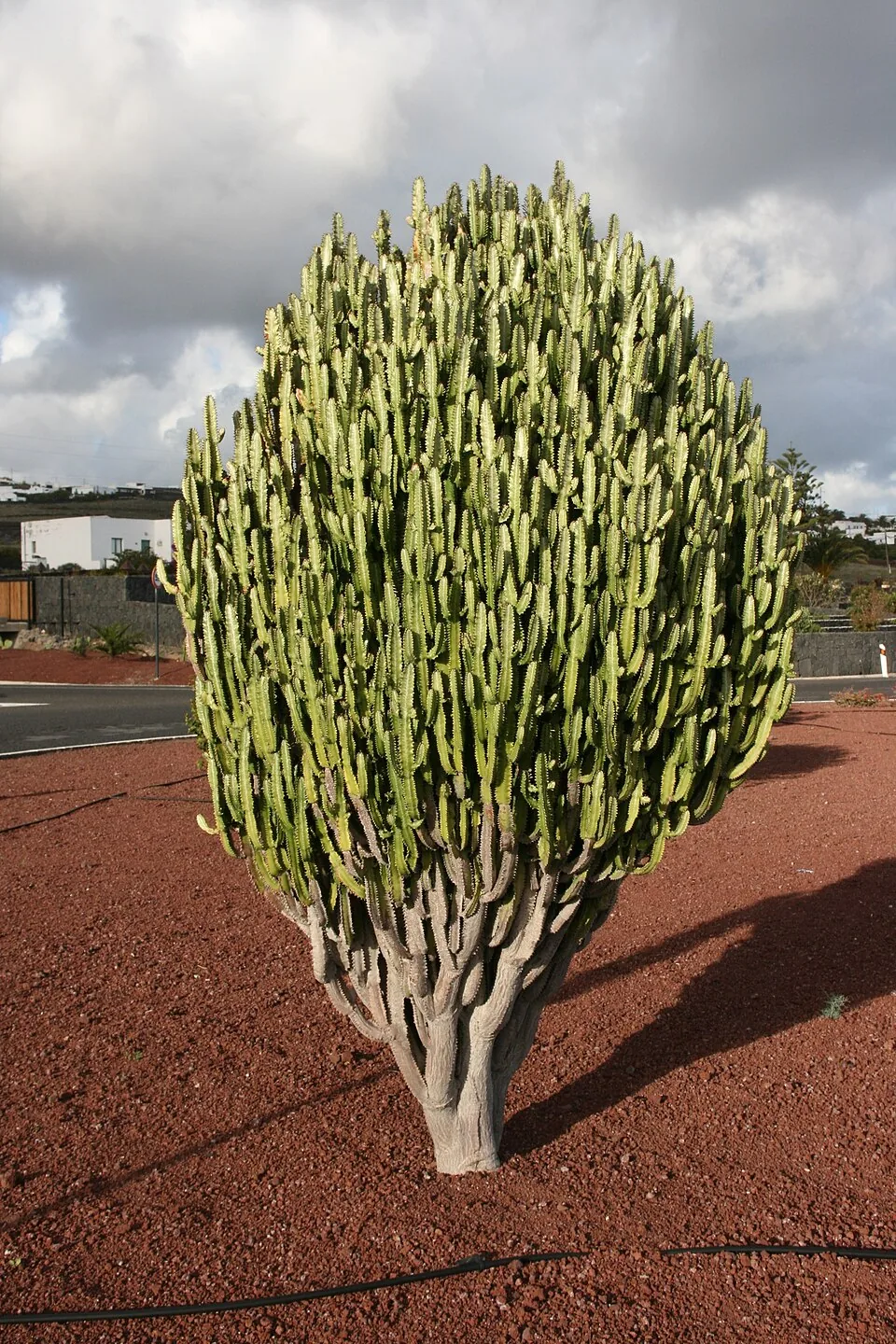
Photo : Frank Vincentz — CC BY-SA 3.0 — source

🌱 Growing conditions
☀️ Light
Very bright light, with gentle sun after acclimation.
💧 Watering
Water thoroughly, then allow the potting mix to dry before watering again.
🌡️ Temperature
18 to 28 °C
💦 Humidity
Low to medium
🪴 Potting mix
Very well-draining, rich in mineral components.
⭐ Difficulty
Easy to moderate
🌱 Growth
Moderate
📏 Mature size
1 to 2.5 m indoors
🌿 Habit
upright and branched
📝 About African milk tree
Description
Euphorbia trigona develops upright succulent stems, usually three-angled, with small spines and temporary leaves along the ridges. With age it takes on a candelabra-like outline and can become top-heavy. It is not a cactus; its white latex sap is irritating and should be avoided whenever the plant is cut.
Care
Very bright light, with gentle sun after acclimation. Water thoroughly, then allow the potting mix to dry before watering again. Above all, avoid abrupt changes in conditions and check the root ball before watering again.
Turn the pot occasionally to reduce leaning toward the window and support very tall specimens; Euphorbia trigona can easily become top-heavy.
Repotting
Repot when roots truly fill the container or the mix has degraded. Choose a pot with drainage holes only slightly larger and use a very well-draining mix rich in mineral components. An unnecessarily large pot keeps moisture around the roots for longer.
Repot Euphorbia trigona with gloves and stabilise the plant before freeing the root ball; spines and latex make a fall or broken stem more troublesome than with an ordinary succulent.
Propagation
Propagate by cuttings or by separating offsets according to the species; allow cuts in succulent tissue to callus before planting.
🐱 Toxicity
Toxic to dogs and cats. Its white latex is irritating: contact can irritate skin and eyes, while ingestion may cause severe digestive irritation. Keep out of reach of children and animals.
🩺 Common problems
Yellow leaves
If several leaves of Euphorbia trigona yellow together, first check the moisture of the potting mix, then light and temperature. A single old leaf may simply be reaching the end of its cycle.
Brown leaves
On Euphorbia trigona, distinguish a dry tip from a soft area: the first often accompanies drying or overly strong sun, while the second points more toward excess moisture.
Diseases
Root problems in Euphorbia trigona become more likely in constantly wet, poorly aerated potting mix. Rapid loss of vigor or a soft base justifies checking the roots.
Pests
Inspect leaf undersides, nodes and young shoots of Euphorbia trigona. If you see stippling, distortion, cottony masses or visible insects, isolate the plant before treating.