Plant profile
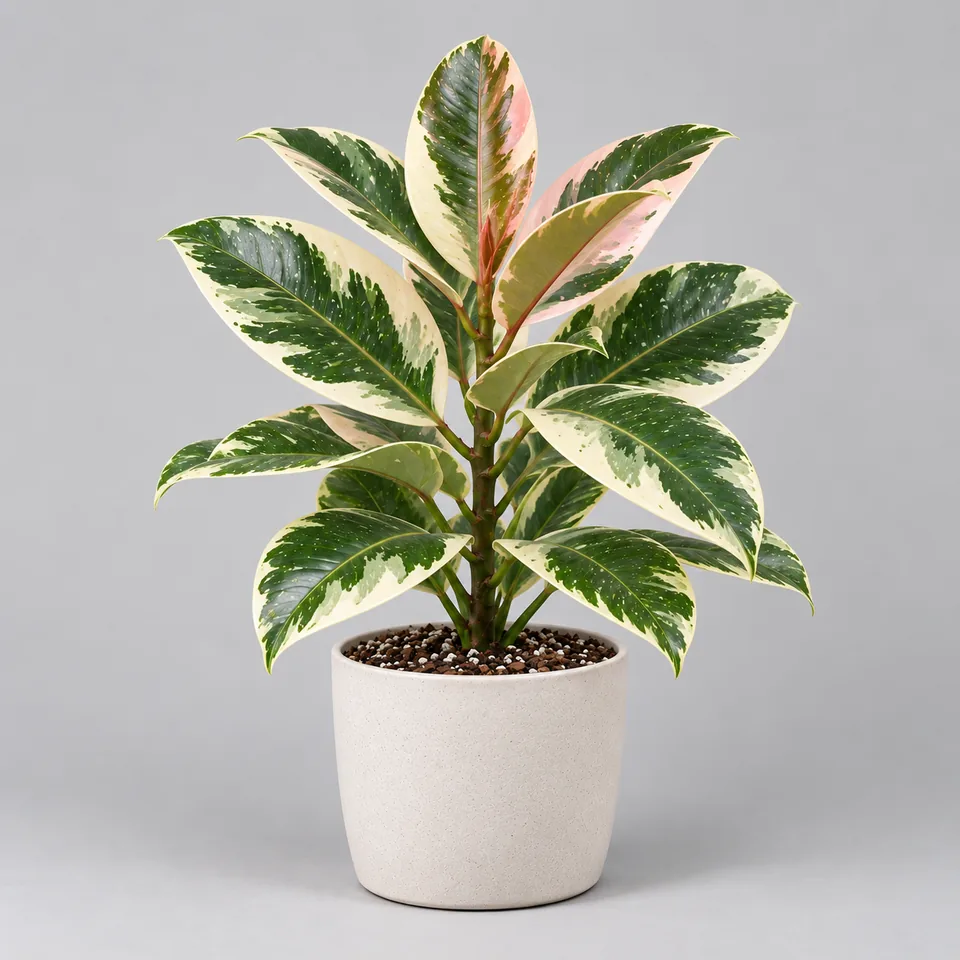
Ficus Tineke
Ficus elastica 'Tineke'
🌱 Growing conditions
☀️ Light
Bright indirect light; a little gentle sun is possible after acclimation.
💧 Watering
Water when the upper 3–5 cm are dry, soaking the root ball and draining excess water.
🌡️ Temperature
18–27 °C.
💦 Humidity
Medium.
🪴 Potting mix
Rich, airy and well-drained.
⭐ Difficulty
Easy to moderate
🌱 Growth
Moderate
📏 Mature size
1.5–3 m indoors
🌿 Habit
Upright and shrub-like
📝 About Ficus Tineke
Description
Ficus elastica 'Tineke' has large, leathery leaves variegated in green and cream, with young growth sometimes showing a subtle pink blush. The variegation is usually brighter and more distinct in a well-lit position.
Like other Ficus elastica, it prefers stable conditions. A sudden move, a cold draft or consistently excessive watering can trigger leaf drop even when the plant otherwise appears healthy.
Its growth is slightly slower than that of a green rubber plant because the cream-colored sectors contain less chlorophyll and therefore produce less energy.
Care
Place it in a very bright position and avoid moving it frequently. A little morning sun can suit it after gradual acclimation.
Water when the top layer of the mix has dried. Thoroughly wet the whole root ball, then empty the saucer. Wipe the large leaves with a damp cloth when they become dusty.
Pruning the growing tip can encourage branching. Wear gloves: the latex sap can irritate the skin.
Repotting
Repot in spring when the roots are crowded, using a pot only slightly larger. Large specimens can simply have the top layer of potting mix renewed in some years.
Propagation
Propagate by stem cuttings or air layering. Air layering is particularly useful on an already tall stem.
🐱 Toxicity
The white latex can irritate skin and mucous membranes; ingestion can cause digestive upset in pets.
🩺 Common problems
Yellow leaves
Overwatering, insufficient light or stress after being moved. An old lower leaf may yellow naturally.
Brown leaves
The cream-colored areas scorch faster in sun. Dry edges can also indicate drought or salt accumulation.
Diseases
Root rot in a pot that stays too wet; leaf spots if the foliage remains wet.
Pests
Scale insects, spider mites and thrips. Inspect leaf undersides, veins and petioles. Fixed brown scales or sticky honeydew often indicate scale insects, while fine stippling with delicate webbing suggests spider mites.