Plant profile
Umbrella fig
Ficus umbellata
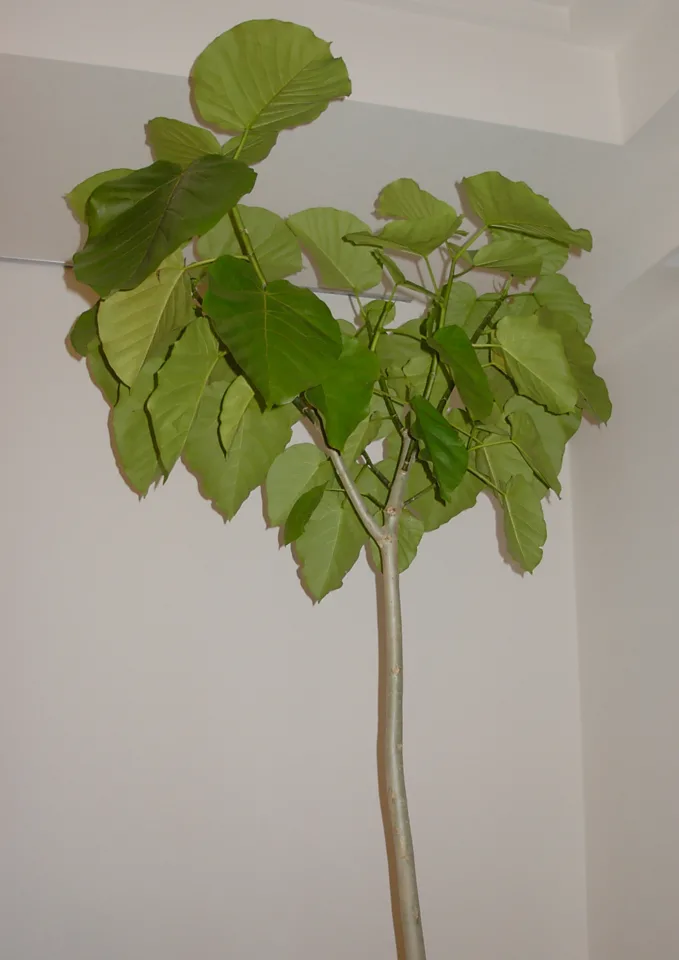
Photo : Kodchiang — CC BY-SA 3.0 — source

🌱 Growing conditions
☀️ Light
Very bright indirect light. A few hours of gentle sun are acceptable.
💧 Watering
Water when the top 3–5 cm of the potting mix have dried.
🌡️ Temperature
18–28 °C
💦 Humidity
Average to high
🪴 Potting mix
Rich, loose and well-drained.
⭐ Difficulty
Moderate
🌱 Growth
Moderate to fast
📏 Mature size
1.5–3 m indoors
🌿 Habit
Upright and tree-like
📝 About Umbrella fig
Description
A striking ficus grown for its large soft heart-shaped leaves on long petioles. It responds strongly to light: in a dark room growth slows, petioles stretch and lower leaves may drop.
Like many indoor Ficus, it values stability as much as warmth. Abrupt changes of position, cold draughts or persistently wet roots can trigger leaf drop even when the plant looked healthy beforehand. Strong filtered light promotes shorter internodes and denser growth.
Care
Place it close to a bright window but protect it from strong midday sun. Water thoroughly when the surface is dry, let the pot drain, and wait for the upper layer to dry again. Wipe the large leaves occasionally and feed lightly during active growth.
Avoid moving or rotating the plant abruptly, especially just after purchase. Water when the upper layer has dried and always empty the saucer. In winter, let the potting mix guide the watering frequency because it can remain moist far longer than in summer. Wipe dust from the leaves and prune lightly in spring if a denser habit is wanted; avoid the irritating latex on the skin.
Average indoor humidity is suitable, but young leaves benefit from air that is not extremely dry. During active growth, light feeding every 4 weeks is enough.
Repotting
Repot in spring when roots strongly fill the container. A pot only a few centimetres wider is better than a large one that stays wet too long. Add perlite, pumice or bark to keep the mix airy.
Repot in spring only when roots clearly circle the root ball or emerge from the pot. Use a container only slightly larger than the root mass and a rich but airy mix. A very large pot remains wet for too long; mature specimens can often be top-dressed instead of repotted every year.
Propagation
Propagate from stem cuttings under warm humid conditions or by air layering. Air layering allows roots to form before the branch is detached.
Semi-ripe stem cuttings root best in warmth and bright indirect light. Wipe away the latex before placing the cutting in the rooting medium. Air layering is particularly useful on larger stems because roots form before the branch is detached from the mother plant.
🐱 Toxicity
The latex is irritating and ingestion is not recommended. Like many Ficus, it can be toxic to cats and dogs.
🩺 Common problems
Yellow leaves
General yellowing often points to overwatering or insufficient light. A few older leaves may yellow naturally as the plant grows.
Brown leaves
Dry tips often reflect irregular watering or very dry air. Pale then brown patches near a window may be sun scorch; foul-smelling roots alongside browning suggest rot.
Diseases
Root rot in persistently wet soil; leaf spots can occur when foliage remains wet in poorly ventilated air.
Pests
Watch for scale insects, spider mites and thrips, especially under leaves and along veins. Isolate the plant if you see stippling, distorted new growth or sticky deposits.