Plant profile
Hoya Krimson Queen
Hoya carnosa 'Krimson Queen'
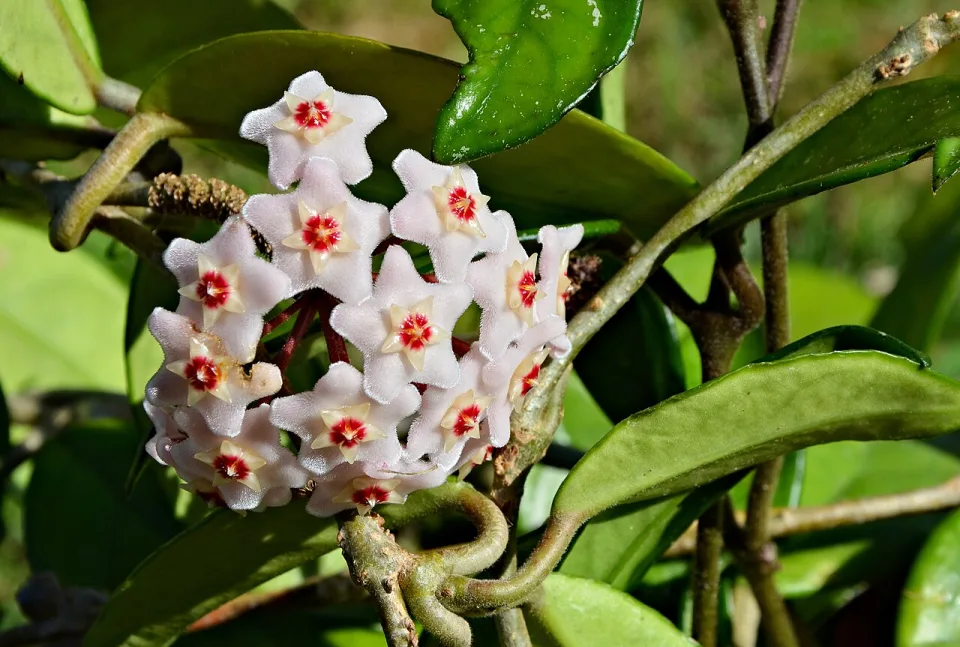
Photo : JLPC — CC BY-SA 3.0 — source

🌱 Growing conditions
☀️ Light
Bright indirect light; a few hours of gentle sun may help flowering after acclimation.
💧 Watering
Allow much of the mix to dry before watering again.
🌡️ Temperature
18–28 °C.
💦 Humidity
Medium.
🪴 Potting mix
Very airy and fast-draining, rich in bark and coarse material.
⭐ Difficulty
Easy to moderate
🌱 Growth
Slow
📏 Mature size
1–2 m trailing stems
🌿 Habit
Trailing and climbing
📝 About Hoya Krimson Queen
Description
Hoya carnosa 'Krimson Queen' has fleshy green leaves edged in cream or white. Young leaves and very pale growth may take on pink tones, especially in good light.
The variegation is mainly concentrated along the margins, which distinguishes it from 'Krimson Princess', where the pale areas are more central. Long flexible stems can twine around a support or trail from a hanging container.
A mature plant receiving enough light can produce rounded umbels of waxy, often fragrant flowers. Old flower spurs should be kept because they can bloom again.
Care
Allow a large part of the pot to dry between waterings and reduce the frequency in winter. Provide abundant light without scorching the white margins. Do not cut off the flower peduncles after blooming. A light fertilizer in spring and summer is sufficient.
Repotting
Hoya appreciate being slightly root-bound. Repot infrequently, using a small pot with drainage holes and a very airy mix.
Propagation
Take stem cuttings with at least one node. They root in water, sphagnum moss or a light mix. An isolated leaf can produce roots without ever producing a new vine.
🐱 Toxicity
Generally regarded as non-toxic to dogs and cats, although sap can irritate sensitive skin.
🩺 Common problems
Yellow leaves
Excess water, overly compact potting mix or low light. A single old leaf may yellow naturally.
Brown leaves
Overly strong sun, extreme drought or damaged roots. The white margins show damage more quickly.
Diseases
Root rot in heavy or constantly wet potting mix.
Pests
Mealybugs and scale insects, and sometimes spider mites. Inspect leaf undersides, nodes and young growth regularly. Silvery scarring, fine stippling, sticky honeydew or cottony clusters often reveal an infestation before it spreads.