Plant profile
Hoya kerrii Variegata
Hoya kerrii 'Variegata'
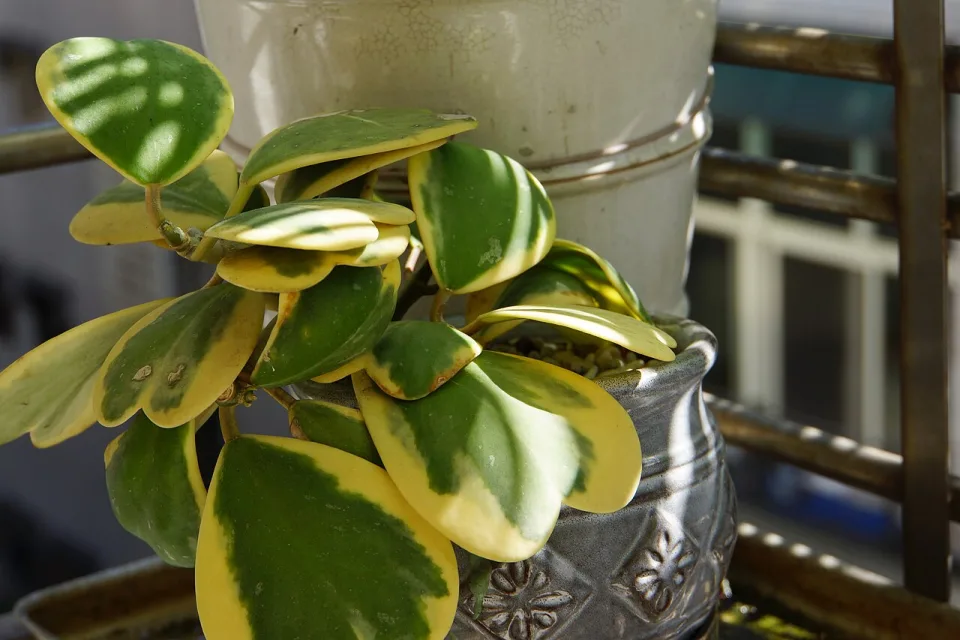
Photo : lienyuan lee — CC BY 3.0 — source

🌱 Growing conditions
☀️ Light
Bright indirect light; a few hours of gentle sun may help flowering after acclimation.
💧 Watering
Allow much of the mix to dry before watering again.
🌡️ Temperature
18–30 °C.
💦 Humidity
Medium.
🪴 Potting mix
Very airy and fast-draining, rich in bark and coarse material.
⭐ Difficulty
Easy to moderate
🌱 Growth
Slow
📏 Mature size
1–2 m trailing stems
🌿 Habit
Trailing and climbing
📝 About Hoya kerrii Variegata
Description
Hoya kerrii 'Variegata' is the variegated form of the famous Hoya with thick heart-shaped leaves. The blades are green with cream or pale-yellow margins and may show pink tones while young.
Small pots sold with a single rooted leaf do not necessarily become complete plants: if the cutting contains no node or piece of stem, it may remain a solitary leaf for years.
A true plant with a node eventually develops a long vine, but growth is slow and is even slower than the green form because of the variegation.
Care
Give it plenty of filtered light and water only after the mix has dried substantially. The thick leaves store water, so overwatering is far more dangerous than a short dry spell. Use a small, well-drained pot.
Repotting
Repot rarely and only once the roots are clearly filling the pot. Avoid large volumes of potting mix around a small root system.
Propagation
Take stem cuttings with at least one node. A leaf on its own can root without ever producing a new stem, an essential point when buying or propagating this plant.
🐱 Toxicity
Generally regarded as non-toxic to dogs and cats, although sap can irritate sensitive skin.
🩺 Common problems
Yellow leaves
Most often caused by excess water or damaged roots. On a single leaf in a small pot, check the moisture level of the potting mix particularly carefully.
Brown leaves
Intense direct sun, extreme drying or a root problem; the pale margins are more sensitive.
Diseases
Root and stem rot develop in heavy, wet mix. If the base softens, darkens or smells sour, inspect the roots and stem, remove rotten tissue and switch to a faster-draining mix.
Pests
Mealybugs and scale insects, and sometimes spider mites. Inspect nodes, leaf undersides and flower peduncles, where mealybugs hide easily. Fine stippling and dull foliage can indicate spider mites.