Plant profile
Shooting-star hoya
Hoya multiflora
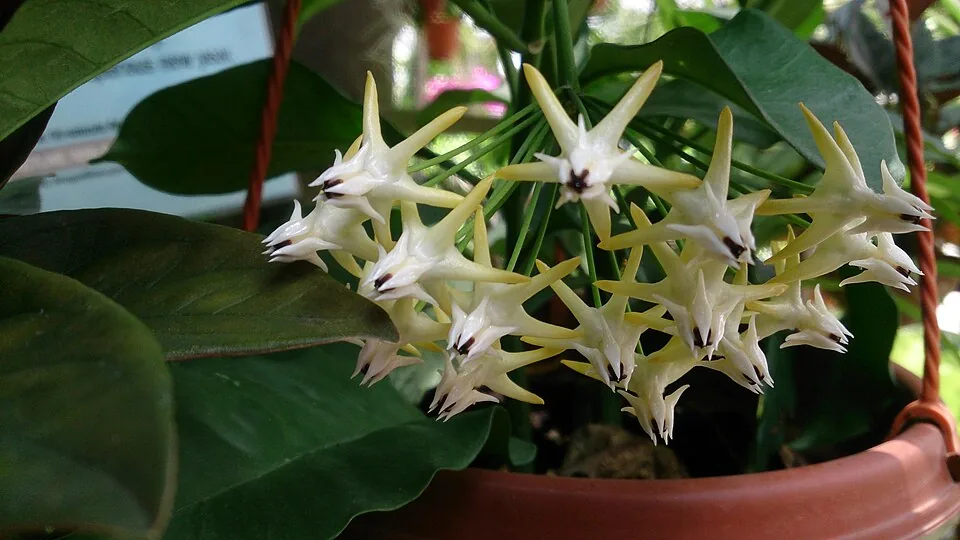
Photo : Mokkie — CC BY-SA 3.0 — source

🌱 Growing conditions
☀️ Light
Bright indirect light; a little gentle sun may encourage flowering.
💧 Watering
Let part of the potting mix dry between waterings; reduce in cool periods.
🌡️ Temperature
18 to 27 °C
💦 Humidity
Medium to high
🪴 Potting mix
Very airy, well-draining substrate suited to epiphytic or semi-succulent plants.
⭐ Difficulty
Moderate
🌱 Growth
Moderate
📏 Mature size
60 to 150 cm
🌿 Habit
shrubby and upright
📝 About Shooting-star hoya
Description
Hoya multiflora differs from many Hoyas by having a more shrubby than climbing habit. Its leaves are elongated and its flower clusters carry many narrow yellow to creamy-white flowers whose reflexed petals create a shooting-star appearance. It therefore needs less training than a large climbing Hoya.
Care
Bright indirect light; a little gentle sun may encourage flowering. Let part of the mix dry between waterings and reduce in cool periods. Avoid abrupt changes and check the root ball before watering again.
Hoya multiflora is more shrubby than climbing; do not force its branches tightly onto a trellis and support them only if they begin to flop.
Repotting
Repot when roots truly fill the container or the mix has degraded. Choose a pot with drainage holes only slightly larger and use a very airy, well-draining substrate suited to epiphytic or semi-succulent plants. An unnecessarily large pot keeps moisture around the roots for longer.
The roots of Hoya multiflora prefer a fairly snug, very airy pot; do not repot merely because a few roots touch the sides if the mix still dries properly.
Propagation
Stem cuttings with several nodes are generally the simplest propagation method.
To propagate Hoya multiflora, use a stem section with at least one node and ideally two leaves; an isolated petiole or leaf does not guarantee formation of a new vine.
🐱 Toxicity
Avoid ingestion; keep out of reach of young children and animals as a precaution.
🩺 Common problems
Yellow leaves
On Hoya multiflora, yellow soft leaves while the medium is still moist point toward excess water or poor aeration. If the medium has been dry for a long time, check instead for dehydration.
Brown leaves
Brown marks on Hoya multiflora can follow abrupt strong sun or a long dry period. A dark soft area calls for quickly checking the roots and stem bases.
Diseases
The roots and base of Hoya multiflora can rot in a compact medium that stays wet. A very airy mix and good drying between waterings clearly reduce the risk.
Pests
Mealybugs readily hide at the nodes and leaf axils of Hoya multiflora. Also inspect the stems for scale insects.