Plant profile
Monstera adansonii Albo
Monstera adansonii 'Albo Variegata'
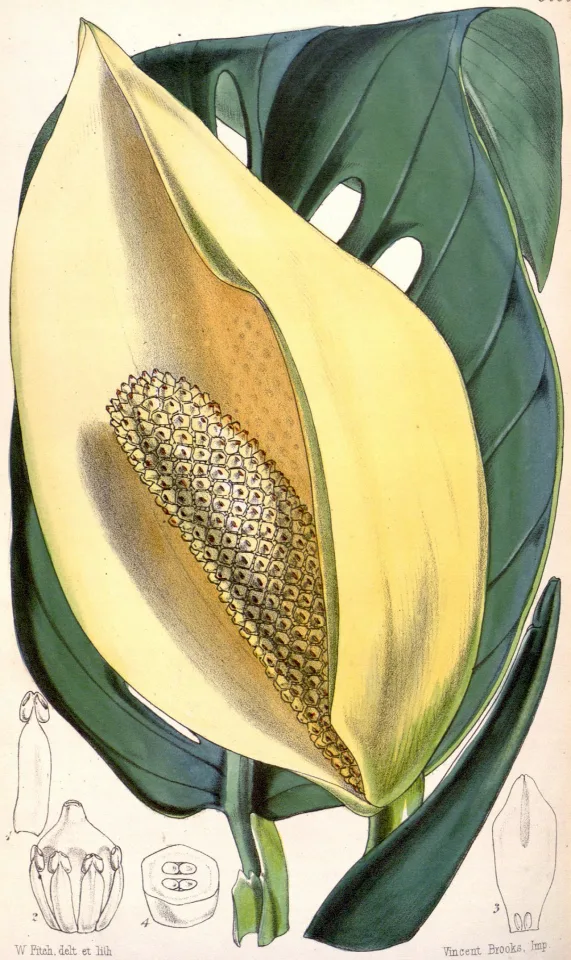
Photo : Walter Hood Fitch — Public domain — source

🌱 Growing conditions
☀️ Light
Bright indirect light; protect pale sectors from strong midday sun.
💧 Watering
Water when the top 3–5 cm are dry, then drain thoroughly.
🌡️ Temperature
18–28 °C; avoid prolonged temperatures below 16 °C.
💦 Humidity
Fairly high, ideally 55–75%, with good air circulation.
🪴 Potting mix
Very airy aroid mix with bark, perlite or pumice and light organic matter.
⭐ Difficulty
Moderate
🌱 Growth
Moderate
📏 Mature size
1–2 m indoors depending on the support
🌿 Habit
Climbing
📝 About Monstera adansonii Albo
Description
Monstera adansonii 'Albo Variegata' combines the naturally perforated leaves of the species with white or cream variegation that can be very pronounced. Some leaves are finely splashed, while others carry large, almost white sectors.
The high proportion of pale tissue slows growth and makes the leaves more delicate. White areas dry more readily and tolerate direct sun poorly, while insufficient light strongly limits the plant's overall vigor.
The habit is climbing. On a vertical support the leaves generally become larger and more structured than on a plant left entirely trailing.
Care
Provide plenty of filtered light and fairly stable atmospheric humidity. Avoid confined conditions, however: high humidity combined with poor air circulation encourages leaf spots.
Allow the surface to dry slightly before watering again. The mix should remain loose and oxygenated, never muddy. Feed lightly during active growth.
Leaves with a very high proportion of white often age faster; this is not necessarily a sign of poor care.
Repotting
Repot into a slightly larger pot when roots are numerous. A suitable mix is light potting soil or coconut fiber combined with bark and perlite or pumice.
Propagation
Take stem cuttings with a node. To maintain a balanced plant, choose a section containing both green and variegated tissue.
🐱 Toxicity
Toxic if ingested because the tissues contain irritating calcium oxalate crystals.
🩺 Common problems
Yellow leaves
Excess water, cold conditions or poorly oxygenated roots are the most common causes. An old lower leaf may yellow naturally.
Brown leaves
White areas brown easily with direct sun, dry air, irregular watering or salt buildup.
Diseases
Root rot and leaf spots in an environment that is too humid and poorly ventilated.
Pests
Mainly thrips and spider mites, but scale insects can also occur. Inspect leaf undersides, nodes and young growth regularly. Silvery scarring, fine stippling, sticky honeydew or cottony clusters often reveal an infestation before it spreads.