Plant profile
Blushing bromeliad
Neoregelia carolinae
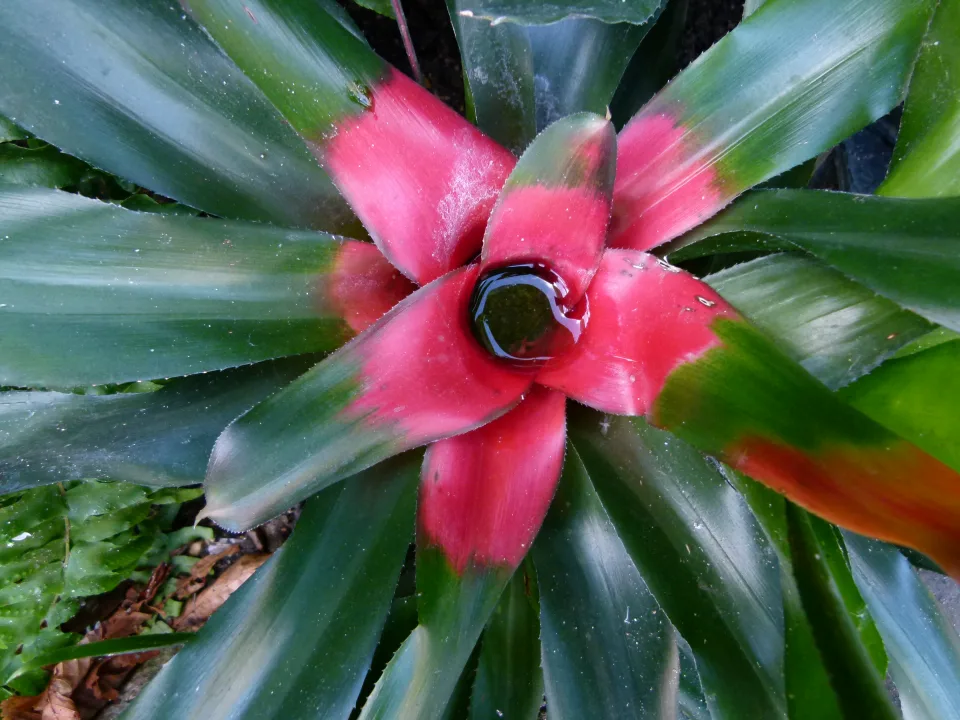
Photo : Dinkum — CC0 — source

🌱 Growing conditions
☀️ Light
Bright indirect light; abundant light usually intensifies the central colour.
💧 Watering
Keep a little soft water in the rosette and replace it regularly; keep the potting mix only lightly moist.
🌡️ Temperature
18–28 °C
💦 Humidity
Average to high
🪴 Potting mix
Very airy and free-draining, suitable for epiphytic bromeliads.
⭐ Difficulty
Easy to moderate
🌱 Growth
Slow
📏 Mature size
30–50 cm
🌿 Habit
Rosette
📝 About Blushing bromeliad
Description
A broad, fairly flat bromeliad rosette. As flowering approaches, the central leaves often turn vivid red or pink around the small inconspicuous flowers. After flowering, the mother rosette declines while offsets take over.
Each rosette flowers only once. The coloured bracts can remain decorative for a long time, but after flowering the mother rosette declines slowly while producing offsets at the base. This gradual ageing is normal and should not be mistaken for sudden plant failure.
Care
Provide plenty of filtered light for good colour. Use soft or low-mineral water in the rosette and renew it regularly; do not leave stale water for weeks. Keep the potting mix airy and only slightly moist.
Use low-mineral water if possible. In warm conditions a small amount of fresh water can be kept in the central cup, but it should be emptied and renewed regularly; in cooler conditions the centre should remain drier. The potting mix itself should stay only lightly moist and very airy. Bright filtered light helps maintain colour without scorching the leaves.
Repotting
The small root system mainly anchors the plant, so a compact stable pot is enough. Repot only when the mix breaks down or offsets fill the container.
The root system is relatively small, so a compact, stable pot is enough. Repot only when the mix has degraded or offsets have crowded the container, using a very airy bromeliad mix rather than dense compost.
Propagation
Separate basal offsets once they are large enough and have some roots, or leave them together to form a fuller clump.
Separate offsets once they have reached roughly one third to one half of the mother rosette's size and have begun to form their own roots, or leave them together for a fuller clump.
🐱 Toxicity
Generally considered of low toxicity; ingestion is not recommended.
🩺 Common problems
Yellow leaves
The mother rosette can yellow naturally after flowering. Rapid yellowing on a young rosette suggests cool, excessive moisture or root problems.
Brown leaves
Dry air, harsh sun or mineral build-up can brown the tips; damage in the centre calls for a check of the crown.
Diseases
Crown and root rot in stagnant wet conditions, especially when cool.
Pests
Scale insects and mealybugs, often hidden between leaf bases. Inspect leaf undersides, nodes and young growth regularly. Silvery scarring, fine stippling, sticky honeydew or cottony clusters often reveal an infestation before it spreads.