Plant profile
Splendid slipper orchid
Paphiopedilum insigne
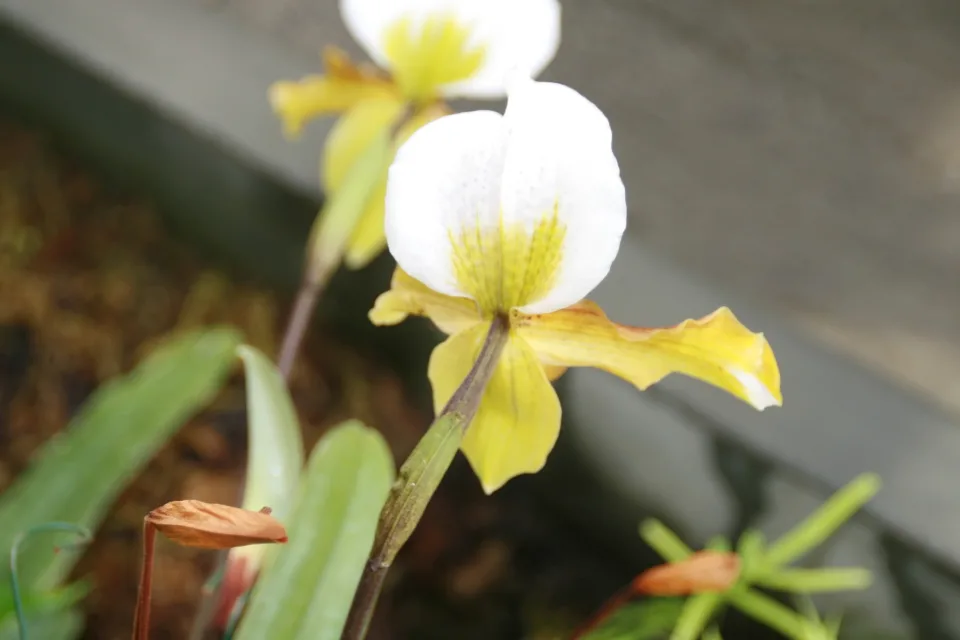
Photo : Photo by David J. Stang — CC BY-SA 4.0 — source

🌱 Growing conditions
☀️ Light
Medium to bright indirect light.
💧 Watering
Keep lightly moist without waterlogging; avoid long periods of complete dryness.
🌡️ Temperature
15–24 °C
💦 Humidity
Average to high with good air movement
🪴 Potting mix
Fine, airy orchid mix that retains slightly more moisture than a typical Phalaenopsis mix.
⭐ Difficulty
Moderate
🌱 Growth
Slow
📏 Mature size
25–45 cm
🌿 Habit
Rosettes forming a clump
📝 About Splendid slipper orchid
Description
A slipper orchid forming rosettes of strap-like leaves. Each mature growth can produce a flower with the characteristic pouch-shaped lip. Because Paphiopedilum lacks water-storing pseudobulbs, its roots prefer more even moisture than many epiphytic orchids.
Unlike many common epiphytic orchids, it has no pseudobulbs in which to store large reserves of water. Its roots therefore prefer more even moisture and should not be left bone dry for long periods. New rosettes gradually form beside older ones and a well-established clump is generally more floriferous than a very small division.
Care
Keep in medium to bright filtered light. Water when the surface begins to dry but before the whole pot becomes completely dry. Use low-mineral water when possible and avoid leaving water in the crown overnight.
Keep it in medium to bright filtered light. Water when the surface is beginning to dry but before the whole pot is completely dry. Use low-mineral water if possible and avoid leaving water in the centre of the rosettes overnight. Moderate humidity should be combined with good air movement.
Repotting
Repot every 1–2 years as the mix breaks down, using a snug pot with drainage and a fine airy bark-based mix that holds some moisture.
Renew the mix every 1 to 2 years as it breaks down. Use a snug pot and a fine, airy orchid mix that holds a little moisture without becoming waterlogged. Do not bury the base of the rosettes too deeply.
Propagation
Divide only well-established clumps and ideally keep several growths in each division. Seed propagation is specialised and requires sterile conditions.
Only divide well-established clumps. Each division should ideally keep several growths, because tiny single-growth divisions recover slowly and may take much longer to flower again.
🐱 Toxicity
Specific toxicity data are limited. Avoid ingestion and prolonged contact with sap on sensitive skin.
🩺 Common problems
Yellow leaves
An older outer leaf may yellow naturally. Several yellow leaves at the same time can indicate potting mix that is too wet or damaged roots.
Also check that the base of the rosette is not buried too deeply.
Brown leaves
Brown tips can follow mineral-rich water, excessive fertiliser or dry air; sun scorch causes more localised patches.
Diseases
Root and crown rot in waterlogged media; bacterial and fungal leaf spots are favoured by wet foliage and stagnant air.
Pests
Mealybugs, scale insects and occasionally spider mites. Inspect the crown, leaf undersides and bases of flower spikes. Scale insects and mealybugs can hide in folds; avoid leaving water in the crown after treatment.