Plant profile
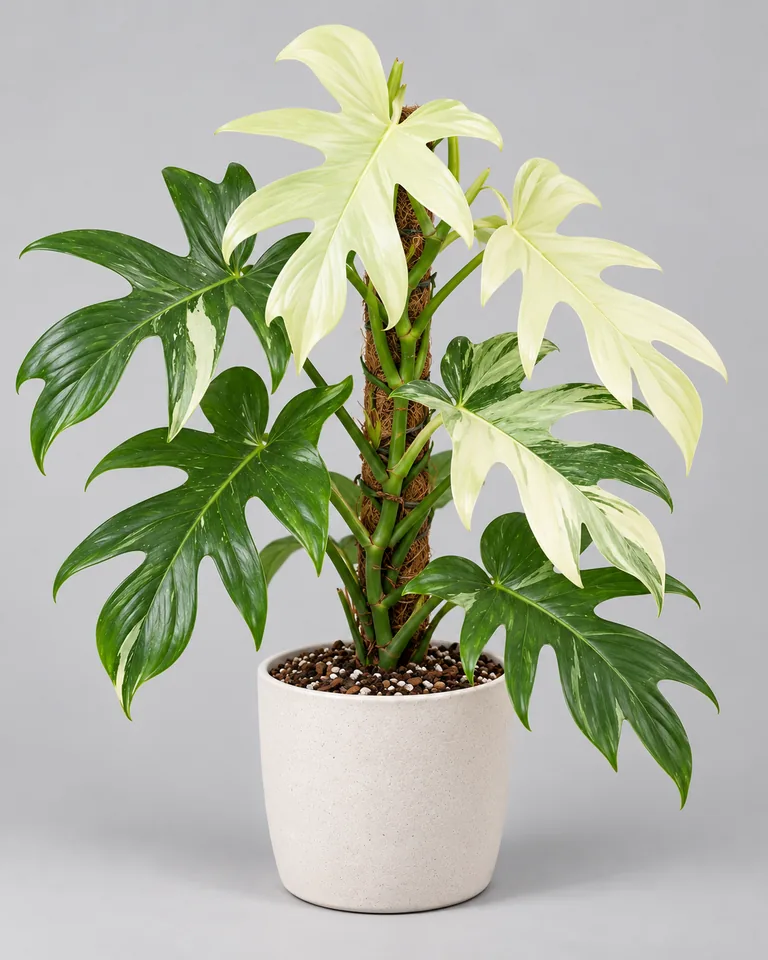
Philodendron Florida Ghost
Philodendron 'Florida Ghost'
🌱 Growing conditions
☀️ Light
Bright indirect light; protect pale sectors from strong midday sun.
💧 Watering
Water when the top 3–5 cm are dry, then drain thoroughly.
🌡️ Temperature
18–28 °C; avoid prolonged temperatures below 16 °C.
💦 Humidity
Medium to high, ideally 50–70 %, with airflow.
🪴 Potting mix
Very airy aroid mix with bark, perlite or pumice and light organic matter.
⭐ Difficulty
Moderate
🌱 Growth
Moderate
📏 Mature size
1–2 m with support
🌿 Habit
Climbing
📝 About Philodendron Florida Ghost
Description
Philodendron 'Florida Ghost' is known for its very pale new leaves, sometimes almost white, which gradually become greener as they mature. Its deeply lobed leaf shape becomes more dramatic as the plant climbs and reaches greater maturity.
The pale color of fresh growth depends strongly on light levels and the stage of leaf development. A leaf that turns greener is not necessarily 'losing' the cultivar; this greening is a normal part of maturation.
A vertical support is important if the goal is to obtain larger leaves and the more impressive adult form of the plant.
Care
Provide bright, filtered light without abruptly exposing the plant to strong sun. A position that is too dark lengthens the internodes and often makes the foliage appear to turn green more quickly.
Water when the mix has partially dried, then allow it to drain. Combine adequate humidity with good air circulation.
Attach the stem loosely to a support. Aerial roots can be guided toward the support or into the potting mix.
Repotting
Repot during active growth into a pot only slightly larger, using a mix of bark, perlite or pumice, fibrous material and light organic matter.
Propagation
Take stem cuttings with at least one node. Allow several roots to develop before potting to reduce transplant stress.
🐱 Toxicity
Toxic if ingested because the tissues contain irritating calcium oxalate crystals.
🩺 Common problems
Yellow leaves
Overwatering and insufficient light are the most common causes of general yellowing.
Brown leaves
Young pale leaves can develop marks after strong sun, dry air or mechanical damage while they are unfurling.
Diseases
Root rot in compact or saturated potting mix; leaf spots can occur when moisture remains on the foliage.
Pests
Thrips, spider mites and scale insects. Inspect newly unfurling leaves, petioles and leaf undersides especially: silvery scars and distortion suggest thrips, fine stippling suggests mites, and fixed clusters or scales indicate scale insects.
On Philodendron 'Florida Ghost', inspect newly rolled leaves, petioles and sheaths first; thrips can hide there before silvery scarring or distortion becomes obvious.