Plant profile
Philodendron Jose Buono
Philodendron 'Jose Buono'
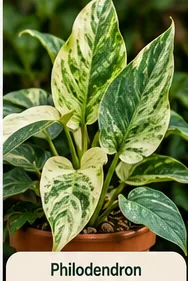
Photo : PlantMinute — Image générée
🌱 Growing conditions
☀️ Light
Very bright indirect light to maintain variegation.
💧 Watering
Water when the top 3–5 cm of mix are dry, then soak thoroughly and let excess water drain. Avoid keeping the root ball constantly wet.
🌡️ Temperature
18 to 28 °C
💦 Humidity
Medium to high
🪴 Potting mix
Very airy and free-draining.
⭐ Difficulty
Moderate
🌱 Growth
Moderate
📏 Mature size
1.5 to 2.5 m on a support
🌿 Habit
climbing
📝 About Philodendron Jose Buono
Description
Philodendron ‘Jose Buono’ is a large climbing philodendron with elongated leaves irregularly variegated in cream, pale yellow and green. On some leaves, the light areas can be very broad.
Variegation varies, but the plant is generally vigorous. Very bright light without scorching sun helps maintain a good balance between growth and colour.
It quickly becomes substantial when trained on a stable support, and the leaves grow larger as the plant matures.
Care
Place it in very bright filtered light. Too little light produces more green and reduces the size of new leaves.
Water when the top few centimetres of the mix are dry. Use a coarse mix so water can move through the pot without excluding all the air.
Gradually secure the main stem to a support. Feed lightly in spring and summer.
Repotting
Repot when the roots fill the pot. Use a container with drainage holes only slightly larger and a very airy aroid mix. Install or strengthen the support at the same time.
Propagation
Take a stem section with at least one node. To preserve variegation, choose a section where both green and pale tissue are visible on the stem. An entirely green section may produce a reverted plant.
🐱 Toxicity
Toxic if ingested because of calcium oxalates.
🩺 Common problems
Yellow leaves
Too much water is the most common cause when yellow leaves are soft and the pot dries slowly. A very pale leaf may also age faster than a greener one.
Brown leaves
Cream areas brown more easily after drought, direct sun or salt build-up. A small brown margin on a large pale area is not necessarily serious.
Diseases
Root rot develops in saturated mix, while leaf spotting is favoured by humid stagnant air and foliage staying wet. Improve drainage, airflow and leaf drying before using any treatment.
Pests
Thrips in particular, followed by scale insects and spider mites. Inspect newly unfurling leaves and leaf undersides especially: silvery streaks and distortion suggest thrips, fine stippling mites, and white cottony clusters mealybugs.