Plant profile
Philodendron Pink Princess
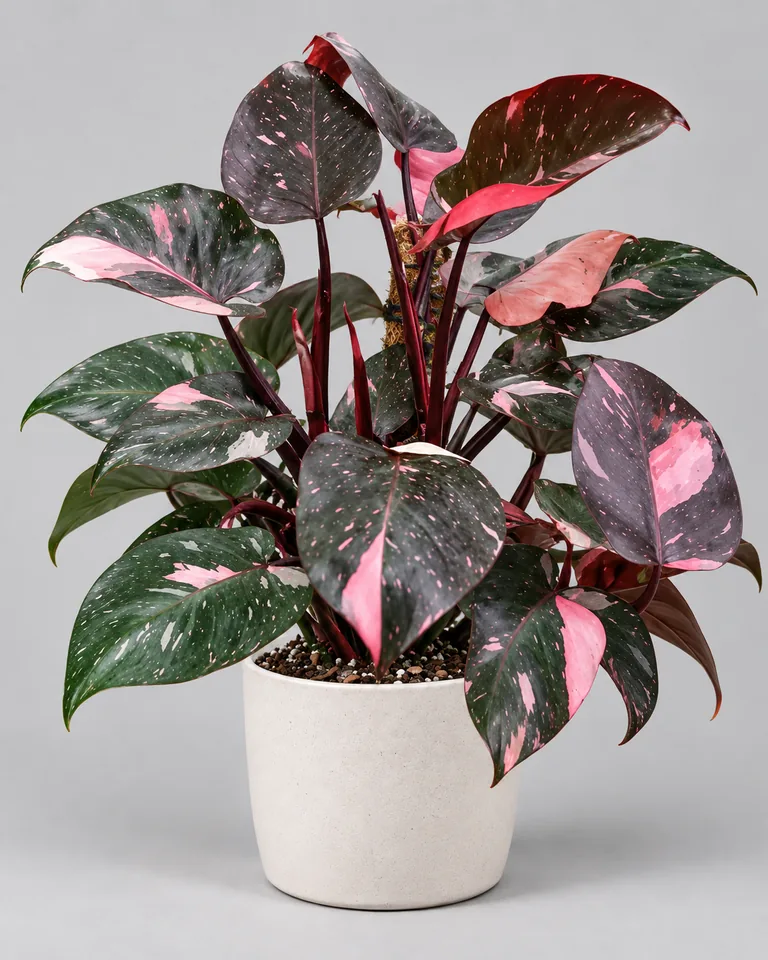
Philodendron erubescens 'Pink Princess'
🌱 Growing conditions
☀️ Light
Bright indirect light; protect pale sectors from strong midday sun.
💧 Watering
Let the top 2–4 cm of the mix dry between waterings.
🌡️ Temperature
18–28 °C; avoid prolonged temperatures below 16 °C.
💦 Humidity
Medium to high, ideally 50–70 %, with airflow.
🪴 Potting mix
Very airy aroid mix with bark, perlite or pumice and light organic matter.
⭐ Difficulty
Moderate
🌱 Growth
Moderate
📏 Mature size
1–2 m with support
🌿 Habit
Climbing
📝 About Philodendron Pink Princess
Description
Philodendron 'Pink Princess' is grown for its dark green to almost brown-black leaves marked with irregular pink sectors. The intensity and amount of pink differ from leaf to leaf because the variegation depends on how differently colored tissues are distributed through the stem.
The best plant is not the one that produces the greatest possible amount of pink, but the one that keeps enough green tissue to sustain growth. Shoots with too little chlorophyll are visually striking but weaken quickly.
This is a climbing Philodendron. With a support and strong indirect light, the leaves can increase in size while the internodes remain shorter and the plant keeps a denser appearance.
Care
Place it in bright, filtered light. Too little light often produces looser growth and can make the variegation less attractive; harsh sun burns the pink areas first.
Water when the surface of the potting mix has dried. The mix should be moist immediately after watering, then quickly regain good aeration. Avoid standing water.
Train the stem on a support. If several new leaves become completely green, pruning above a node showing more variegation may sometimes help, although there is no guarantee.
Repotting
Repot when the root ball is well colonized, using a slightly larger pot with drainage holes. A coarse aroid mix reduces the risk of oxygen-starved roots.
Propagation
Take stem cuttings with at least one node. To retain the pink variegation, choose a section whose stem itself shows variegated areas.
Root with warmth and strong indirect light without saturating the rooting medium.
🐱 Toxicity
Toxic if ingested because the tissues contain irritating calcium oxalate crystals.
🩺 Common problems
Yellow leaves
The most common causes are overwatering, insufficient light or damaged roots. An old lower leaf may yellow naturally.
Brown leaves
Pink areas brown more readily in dry air, strong sun or under water stress. Soft, dark-brown tissue points more toward rot.
Diseases
Root rot in overly wet mixes; bacterial or fungal leaf spots are also possible if the foliage remains wet.
Pests
Thrips, spider mites and scale insects, especially on young leaves. Inspect leaf undersides, nodes and young growth regularly. Silvery scarring, fine stippling, sticky honeydew or cottony clusters often reveal an infestation before it spreads.