Plant profile
Philodendron tortum
Philodendron tortum
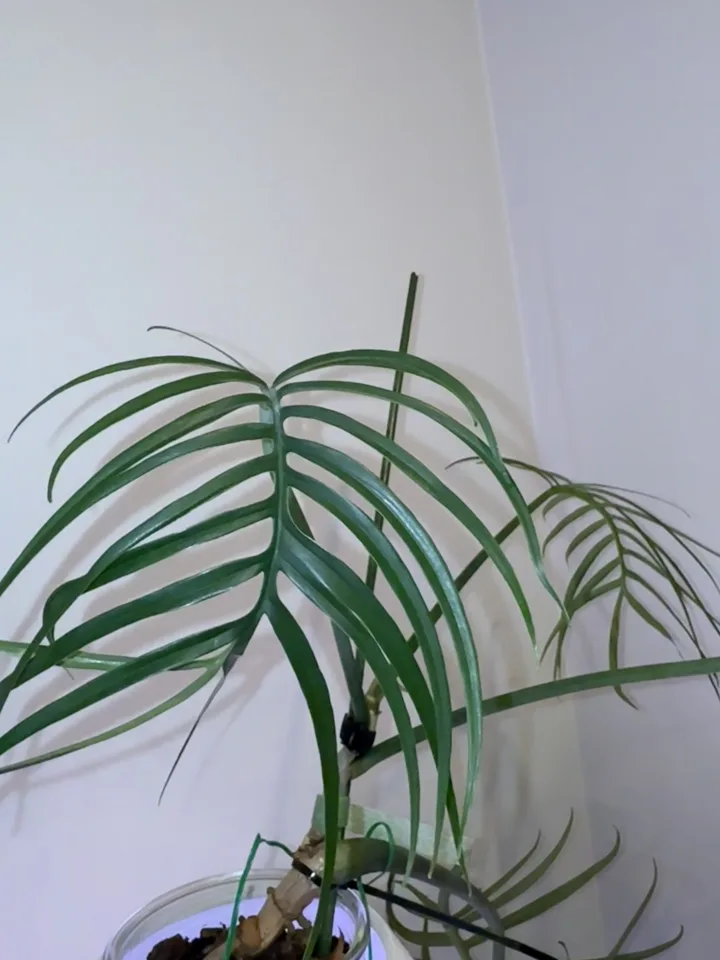
Photo : DocJ94 — CC BY-SA 4.0 — source

🌱 Growing conditions
☀️ Light
Bright indirect light.
💧 Watering
Water when the top 3–5 cm are dry.
🌡️ Temperature
18 to 28 °C
💦 Humidity
Medium to high
🪴 Potting mix
Very airy, coarse and free-draining.
⭐ Difficulty
Moderate
🌱 Growth
Moderate
📏 Mature size
1 to 2 m on a support
🌿 Habit
climbing
📝 About Philodendron tortum
Description
Philodendron tortum is instantly recognisable by its leaves, which are divided very deeply into narrow segments, giving them an almost palm-like or skeletal look. Its outline is quite unlike that of broad, entire-leaved philodendrons.
It is a climber that clearly benefits from a support, producing larger leaves and a more orderly habit as it matures.
Despite its delicate appearance, it is fairly robust when the roots stay aerated and watering follows the actual drying rate of the pot.
Care
Place it in bright filtered light. Too little light lengthens the internodes and reduces leaf size.
Water when the top few centimetres are dry. Use a coarse, airy mix.
Guide the stem up a support and avoid snapping the relatively slender petioles. Feed lightly during active growth.
Repotting
Repot when the roots fill the pot well. A slightly larger container is enough. Install the support while repotting so you do not damage the roots later.
Propagation
Take stem cuttings with at least one node and root them in water, sphagnum or a very airy mix. A leaf without a node will not produce a new plant.
🐱 Toxicity
Toxic if ingested because of calcium oxalates.
🩺 Common problems
Yellow leaves
Too much water, a compact mix or low light are the main causes. An older leaf may yellow naturally.
Brown leaves
Dry tips appear with low humidity or prolonged drought. Strong direct sun can scorch the narrow leaf segments.
Diseases
Root rot in saturated mix. If several leaves yellow at once or the stem base softens, remove the root ball, cut away brown mushy roots and repot into a more aerated mix before watering again.
Pests
Thrips, spider mites and scale insects.