Plant profile
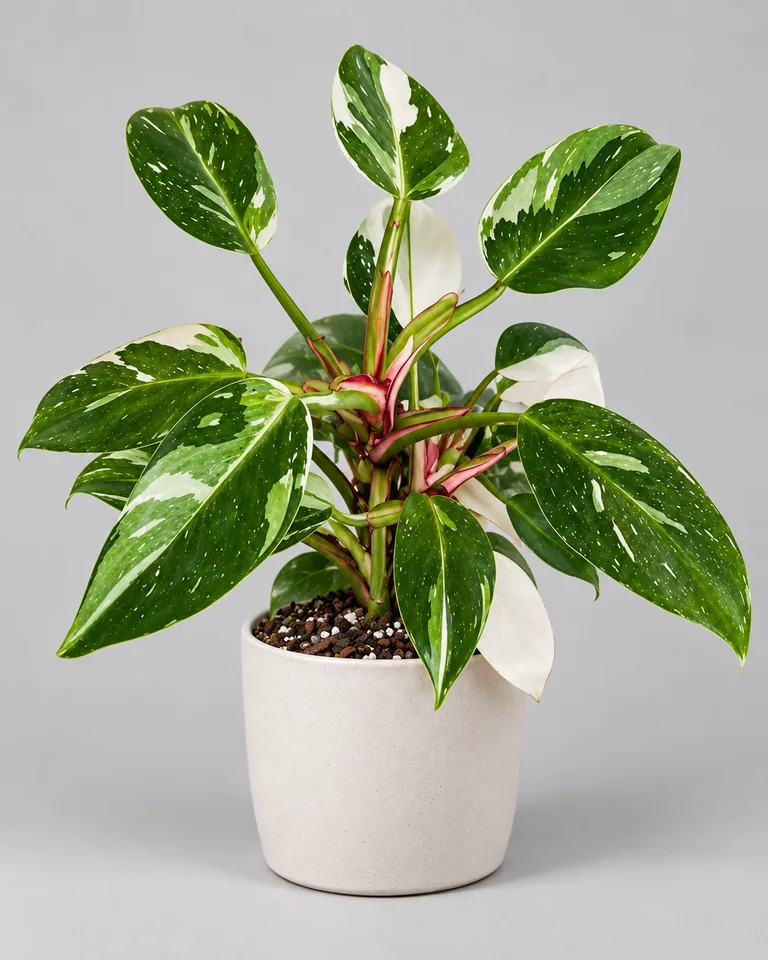
Philodendron White Princess
Philodendron 'White Princess'
🌱 Growing conditions
☀️ Light
Bright indirect light; protect pale sectors from strong midday sun.
💧 Watering
Water when the top 3–5 cm are dry, then drain thoroughly.
🌡️ Temperature
18–28 °C; avoid prolonged temperatures below 16 °C.
💦 Humidity
Medium to high, ideally 50–70 %, with airflow.
🪴 Potting mix
Very airy aroid mix with bark, perlite or pumice and light organic matter.
⭐ Difficulty
Moderate
🌱 Growth
Moderate
📏 Mature size
60 cm–1.2 m
🌿 Habit
Climbing
📝 About Philodendron White Princess
Description
Philodendron 'White Princess' combines dark green foliage with crisp white sectors, while its petioles and sheaths may also show cream or pinkish tones. It is often confused with 'White Wizard' and 'White Knight', but the coloration of the petioles and cataphylls is one of the useful features for telling them apart.
Its variegation is unpredictable, and each new leaf may look very different from the previous one. White tissue performs little to no photosynthesis, so highly variegated plants usually grow more slowly than greener specimens.
The plant remains fairly compact while young, but as the stem lengthens it benefits increasingly from a vertical support.
Care
Give it plenty of indirect light and avoid sudden changes in exposure. Strong direct sun easily burns the white sectors.
Allow the top layer of the mix to dry before watering, then let it drain completely. Do not try to compensate for strong light by watering more often while the potting mix is still wet.
Clean the leaves gently and support the stem when it begins to lengthen.
Repotting
Repot only once the roots are filling the pot well. Choose a container only slightly larger and a coarse mix that allows good air circulation around the roots.
Propagation
Take stem cuttings containing a node. To preserve attractive variegation, favor a node whose stem displays both green and white tissue.
🐱 Toxicity
Toxic if ingested because the tissues contain irritating calcium oxalate crystals.
🩺 Common problems
Yellow leaves
Several yellow leaves often indicate a root ball that is staying too wet. Insufficient light can make the problem worse by slowing drying.
Brown leaves
White areas brown with direct sun, very dry air, irregular watering or excessive salt buildup.
Diseases
Root rot and leaf spots when excess moisture is combined with poor ventilation.
Pests
Thrips, spider mites, mealybugs and scale insects. Inspect leaf undersides, nodes and young growth regularly. Silvery scarring, fine stippling, sticky honeydew or cottony clusters often reveal an infestation before it spreads.