Plant profile
Swedish ivy
Plectranthus verticillatus
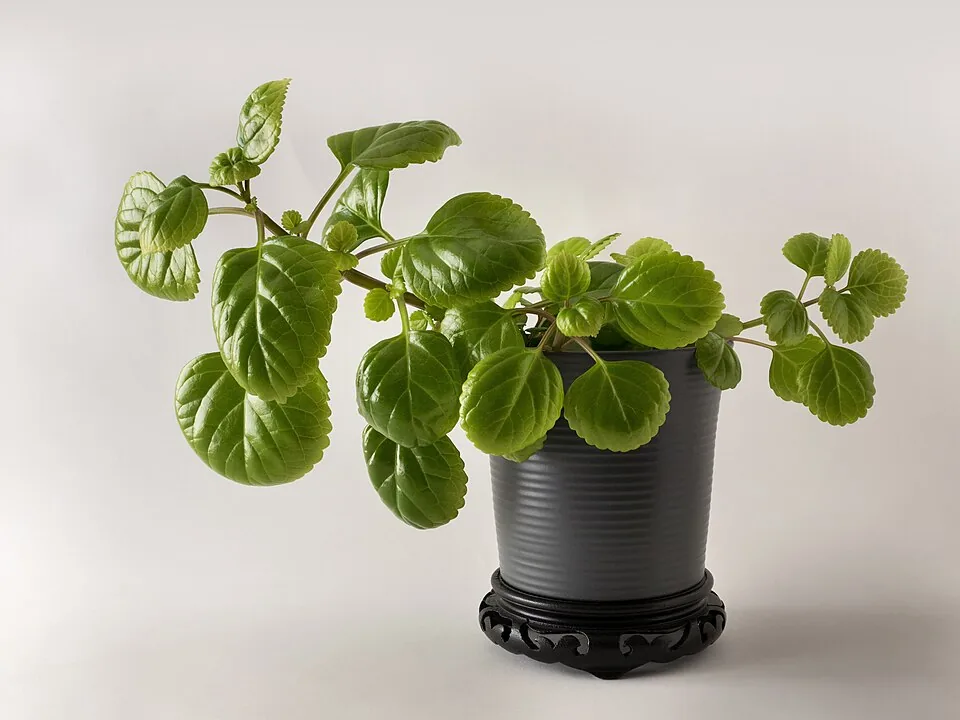
Photo : W.carter — CC0 — source

🌱 Growing conditions
☀️ Light
Bright indirect light; protect from scorching sun.
💧 Watering
Water when the first few centimeters of potting mix begin to dry, without leaving standing water.
🌡️ Temperature
18 to 27 °C
💦 Humidity
Medium to high
🪴 Potting mix
Rich, airy and well-draining.
⭐ Difficulty
Moderate
🌱 Growth
Moderate to fast
📏 Mature size
20 to 40 cm, stems trailing 50 to 100 cm
🌿 Habit
trailing
📝 About Swedish ivy
Description
Plectranthus verticillatus, commonly called Swedish ivy, is an evergreen perennial with flexible creeping or trailing stems. Opposite, rounded to oval leaves quickly form a mass of foliage in a hanging basket or over the edge of a container.
The plant branches readily when shoot tips are pinched or cut back. Regular pruning keeps it dense and helps prevent long stems from becoming bare near the pot.
It prefers bright light without scorching sun and a well-drained potting mix. Its fast growth and easy propagation from cuttings also make it simple to renew an older plant that has become sparse.
Care
Bright indirect light; protect from scorching sun. Water when the first few centimeters of potting mix begin to dry, without leaving standing water. Above all, avoid abrupt changes in conditions and check the root ball before watering again.
Pinch the tips of Plectranthus verticillatus often if you want compact growth; long unpruned stems become bare near the pot more easily.
Repotting
Repot when roots truly fill the container or the mix has degraded. Choose a pot with drainage holes only slightly larger and use a rich, airy, well-draining mix. An unnecessarily large pot retains moisture around the roots for longer.
Its stems root very easily; when repotting, an old hanging plant can be rejuvenated by replanting several rooted tips in fresh mix rather than keeping every old stem.
Propagation
The simplest method is a stem-tip cutting. Take a healthy shoot with several nodes, remove the lower leaves and root it in water or in a light potting mix kept only slightly moist.
Keep the cutting warm in bright indirect light. Once a good root system has formed, plant several cuttings together if you want a dense pot quickly.
🐱 Toxicity
Considered non-toxic to dogs and cats. This is consistent with Swedish ivy Plectranthus listed as non-toxic by the ASPCA.
🩺 Common problems
Yellow leaves
If several leaves of Plectranthus verticillatus yellow together, first check potting-mix moisture, then light and temperature. A single old leaf may simply be reaching the end of its cycle.
Brown leaves
On Plectranthus verticillatus, distinguish a dry tip from a soft area: the first often accompanies drying or overly strong sun, while the second points more toward excess moisture.
Diseases
Root problems in Plectranthus verticillatus become more likely in constantly wet, poorly aerated potting mix. Rapid loss of vigor or a soft base justifies checking the roots.
Pests
Inspect leaf undersides, nodes and young shoots of Plectranthus verticillatus. If you see stippling, distortion, cottony masses or visible insects, isolate the plant before treating.