Plant profile
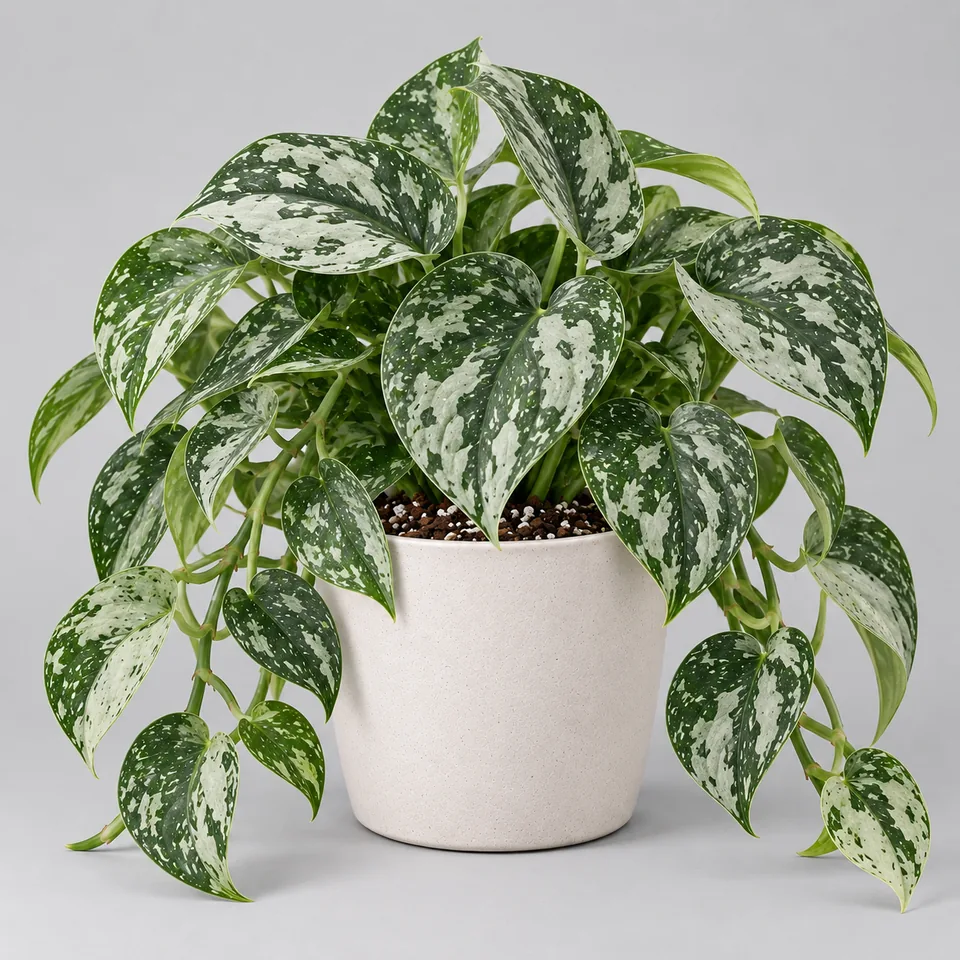
Scindapsus Exotica
Scindapsus pictus 'Exotica'
🌱 Growing conditions
☀️ Light
Medium to bright indirect light.
💧 Watering
Let several centimetres of the upper mix dry before watering.
🌡️ Temperature
18–28 °C.
💦 Humidity
Medium to high.
🪴 Potting mix
Very airy and well-drained.
⭐ Difficulty
Easy to moderate
🌱 Growth
Moderate
📏 Mature size
1–3 m of stem indoors
🌿 Habit
Climbing or trailing
📝 About Scindapsus Exotica
Description
Scindapsus pictus 'Exotica' has large satin-textured dark green leaves broadly covered with silver markings. It is often sold as satin pothos, even though it belongs to the genus Scindapsus rather than Epipremnum.
Its leaves are thicker and its growth is usually slower than that of golden pothos. It can either trail from a hanging container or be trained upward on a support.
Generous indirect light usually strengthens the silver contrast and helps keep the internodes shorter and the plant denser.
Care
Place it in medium to bright light without intense sun. Allow the mix to dry partially between waterings; the thick leaves tolerate a slight delay.
A vertical support helps it produce larger leaves. Avoid standing water and oversized pots.
Repotting
Repot when the roots fill the container, using an airy mix based on potting soil, bark and perlite.
Propagation
Take stem cuttings containing at least one node and root them in water, sphagnum moss or a light medium.
🐱 Toxicity
Toxic if ingested because the tissues contain irritating calcium oxalate crystals.
🩺 Common problems
Yellow leaves
Most often caused by excess water. A single lower leaf may simply be aging naturally.
Brown leaves
Prolonged drought, direct sun or excess salts. Soft patches suggest a moisture-related problem.
Diseases
Root rot in saturated potting mix. If several leaves yellow or soften while the mix remains wet, check roots and crown. Remove black or mushy tissue, improve drainage and resume watering only after the mix starts to dry.
Pests
Thrips, spider mites and scale insects.