Plant profile
Scindapsus Jade Satin
Scindapsus pictus 'Jade Satin'
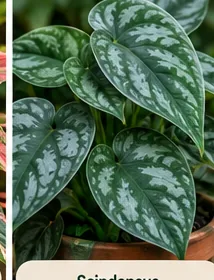
Photo : PlantMinute — Image générée
🌱 Growing conditions
☀️ Light
Medium to bright indirect light.
💧 Watering
Let the top 3–5 cm dry before watering.
🌡️ Temperature
18 to 28 °C
💦 Humidity
Medium to high
🪴 Potting mix
Airy, light and free-draining.
⭐ Difficulty
Easy to moderate
🌱 Growth
Moderate
📏 Mature size
Stems 1 to 2 m
🌿 Habit
climbing or trailing
📝 About Scindapsus Jade Satin
Description
Scindapsus pictus ‘Jade Satin’ has thick, matte, almost uniformly dark-green leaves with little or no silver mottling. Its look is more understated and velvety than cultivars such as ‘Exotica’ or ‘Silvery Ann’.
It grows more slowly than a typical pothos but remains robust if the roots stay well aerated. It can trail from a shelf or be trained up a support.
Adequate light helps keep the foliage compact and thick without requiring intense direct sun.
Care
Grow it in medium to bright indirect light. Too little light slows an already moderate growth rate.
Water when the top few centimetres of the mix are dry. The thick leaves tolerate a short delay in watering, but not repeated long droughts.
Let it climb if you want larger leaves. Prune overly long vines to encourage branching.
Repotting
Repot when the roots fill the pot well. Use a container with drainage holes only slightly larger. An airy aroid mix with bark, perlite or pumice and light organic matter works well.
Propagation
Take stem cuttings with at least one node. They root in water, sphagnum or a light mix. A leaf without a node cannot produce a new stem.
🐱 Toxicity
Toxic if ingested because of calcium oxalates.
🩺 Common problems
Yellow leaves
Too much water, a compact mix or low light are the most common causes. A lower old leaf may yellow naturally.
Brown leaves
Dry edges occur after prolonged drought or in very dry air. Direct sun can cause tan-brown spots.
Diseases
Root rot develops mainly when the mix stays saturated. If stems soften or the mix smells sour, inspect the roots immediately, remove rotten tissue and improve drainage.
Pests
Watch for thrips, scale insects and spider mites, especially under leaves and around nodes. Isolate the plant if new growth becomes distorted, stippled or sticky.