Plant profile
Scindapsus Silvery Ann
Scindapsus pictus 'Silvery Ann'
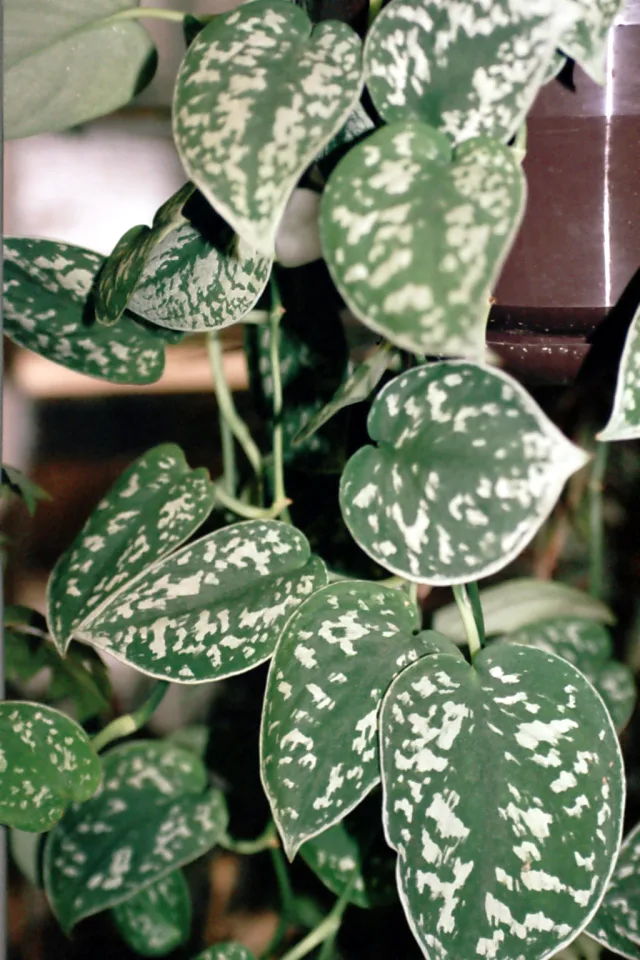
Photo : Kor!An (Корзун Андрей) — CC BY-SA 3.0 — source

🌱 Growing conditions
☀️ Light
Medium to bright indirect light.
💧 Watering
Let several centimetres of the upper mix dry between waterings, then water thoroughly and let it drain completely.
🌡️ Temperature
18–28 °C; avoid prolonged temperatures below 15–16 °C.
💦 Humidity
Medium to fairly high, ideally around 50–70 %, with good air circulation.
🪴 Potting mix
Very airy and well-drained.
⭐ Difficulty
Easy to moderate
🌱 Growth
Moderate
📏 Mature size
1–2 m of stem indoors depending on support.
🌿 Habit
Climbing or trailing
📝 About Scindapsus Silvery Ann
Description
Scindapsus pictus 'Silvery Ann' has dark green, heart-shaped, satin-textured leaves covered with broad irregular silver patches. The silver area is usually more extensive than on many other forms of Scindapsus pictus, giving the foliage an almost metallic appearance in side light.
It can trail from a shelf or hanging basket, but develops larger leaves when trained upward on a support. Growth is slower than ordinary pothos, and its thick foliage tolerates a short dry spell better than constantly waterlogged compost.
Generous indirect light helps keep the internodes short and the silver contrast strong. In a room that is too dark, new leaves tend to be smaller and less silvery.
Care
Place it near a bright window without scorching midday sun. Rotate the pot regularly if the light comes mainly from one side so that growth remains balanced.
Water only after the potting mix has partially dried. The thick leaves provide a small water reserve, so a few days late is safer than keeping the pot permanently wet. A light fertilizer application every 4 to 6 weeks in spring and summer is enough.
If you want larger leaves, train the stems up a stake or plank covered with a slightly rough material.
Repotting
Repot when the roots are filling the pot well, generally every 1 to 2 years for a young plant. Choose a container only slightly larger and always with drainage holes.
Avoid fine, compact potting mixes. A blend containing bark and a mineral component preserves air pockets around the roots and greatly reduces the risk of rot.
Propagation
Take a piece of stem carrying at least one node and ideally a healthy leaf. The node is essential: a leaf on its own cannot produce a complete new vine.
Cuttings root in water, sphagnum moss or a very light medium. Wait until several well-formed roots have developed before potting, and group several cuttings together if you want a fuller pot.
🐱 Toxicity
Toxic if ingested because the tissues contain irritating calcium oxalate crystals.
🩺 Common problems
Yellow leaves
Several yellow, soft leaves, especially while the potting mix remains wet, often indicate excess water or insufficient oxygen around the roots. A single old leaf may simply be aging.
Brown leaves
Dry edges can follow a long period without water, very dry air or excess salts. Soft, dark-brown areas point more toward excessive moisture.
Diseases
Mainly root rot in compact or constantly wet potting mix; leaf spots are possible if the leaves remain wet and ventilation is poor.
Pests
Thrips, spider mites and scale insects, particularly on the undersides of leaves and in young shoots.