Plant profile
Syngonium Milk Confetti
Syngonium podophyllum 'Milk Confetti'
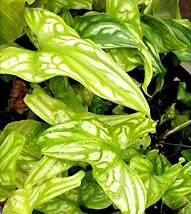
Photo : GinyLee987 — CC BY-SA 4.0 — source

🌱 Growing conditions
☀️ Light
Medium to bright indirect light; good light keeps the pink color stronger.
💧 Watering
Water when the top 2–4 cm are dry.
🌡️ Temperature
18–28 °C.
💦 Humidity
Medium to high.
🪴 Potting mix
Airy, rich and well-drained.
⭐ Difficulty
Easy
🌱 Growth
Fast
📏 Mature size
stems 1–2 m long
🌿 Habit
Climbing or trailing
📝 About Syngonium Milk Confetti
Description
Syngonium 'Milk Confetti' has very pale, milky-green to cream foliage sprinkled with small pink spots that resemble confetti. New leaves are especially decorative, and the amount of pink can vary markedly from one leaf to another.
Its pale overall color does not mean it wants direct sun: light-colored leaves scorch quickly behind a hot window. It nevertheless needs good indirect light to maintain compact growth and an attractive pattern.
With age, the stems lengthen like those of other Syngoniums and can be allowed to trail, pruned back, or trained on a support.
Care
Provide generous filtered light, stable temperatures and regular watering without saturation. Let the surface dry slightly. Pinch regularly to create a dense clump and avoid overly concentrated fertilizer on this pale foliage.
Repotting
Repot when the roots fill the pot, using a rich but sufficiently airy mix that can dry between waterings.
Propagation
Take stem cuttings with a node; they root very easily in water or a light potting mix.
🐱 Toxicity
Toxic if ingested because the tissues contain irritating calcium oxalate crystals.
🩺 Common problems
Yellow leaves
Most often caused by excess water; low light slows drying and increases the risk.
Brown leaves
Pale leaves brown after direct sun, drought, low humidity or salt accumulation.
Diseases
Root rot and leaf spots when moisture stagnates.
Pests
Thrips, spider mites and scale insects. Inspect newly unfurling leaves, petioles and leaf undersides especially: silvery scars and distortion suggest thrips, fine stippling suggests mites, and fixed clusters or scales indicate scale insects.
On Syngonium podophyllum 'Milk Confetti', watch young leaves while they are still rolled; thrips can damage the tissue before opening and later cause scars or distorted variegation that can be mistaken for a colour irregularity.