Plant profile
Sky plant
Tillandsia ionantha
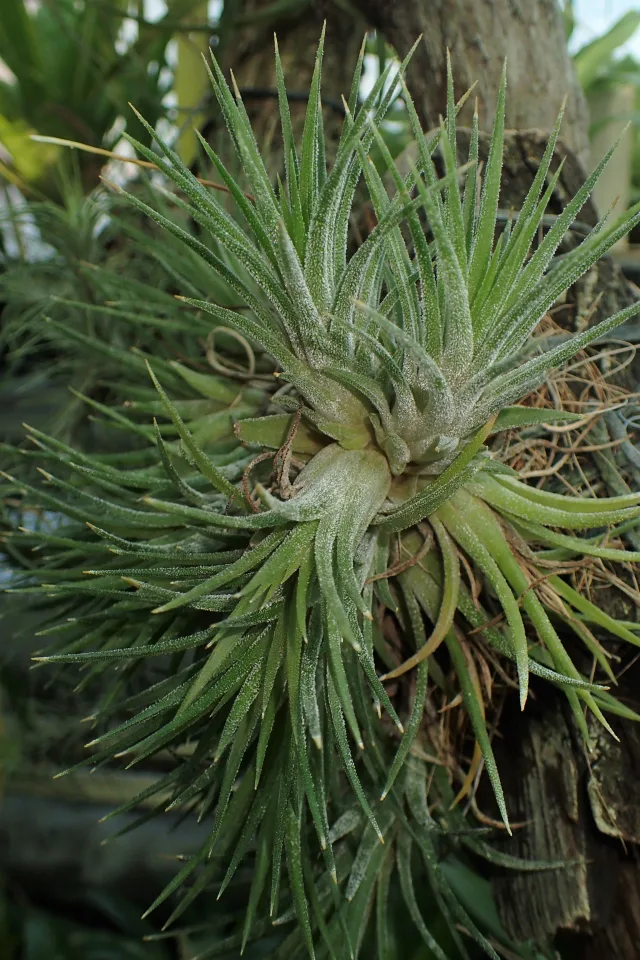
Photo : Krzysztof Ziarnek, Kenraiz — CC BY-SA 4.0 — source

🌱 Growing conditions
☀️ Light
Bright indirect light; gentle sun is suitable after acclimation.
💧 Watering
Wet or soak thoroughly, then allow the plant to dry completely and quickly; adjust frequency to heat and humidity.
🌡️ Temperature
18–28 °C
💦 Humidity
Average, with excellent air circulation
🪴 Potting mix
No potting mix required; grown as an epiphyte.
⭐ Difficulty
Moderate
🌱 Growth
Slow
📏 Mature size
8–15 cm
🌿 Habit
Small epiphytic rosette
📝 About Sky plant
Description
A small epiphytic bromeliad that naturally grows attached to branches or rocks without soil. Water and nutrients are absorbed largely through the leaves. Before flowering the rosette may flush red or pink and then produce violet tubular flowers.
This epiphytic bromeliad does not need soil. Its roots are used mainly for anchoring, while water is absorbed largely through the leaves. Success depends on a cycle of thorough wetting followed by rapid, complete drying.
Care
Keep it very bright and well ventilated. One or more times a week depending on conditions, wet or briefly soak the plant, then shake off excess water and let it dry within a few hours. If water remains in the centre, dry the plant upside down.
Place it in very bright light with good air movement. After soaking or thoroughly wetting the plant, shake out trapped water and let it dry within a few hours; if necessary, dry it upside down so that water cannot remain in the centre. Needs rise in hot, dry weather and fall sharply in cool, humid conditions.
Repotting
No conventional repotting is needed. It can be placed or mounted on untreated wood, cork or another open support that does not trap water.
No conventional repotting is needed. Mount or place it on an untreated, well-ventilated support that does not trap water around the base. Avoid closed containers with poor airflow.
Propagation
After flowering, separate offsets when they reach at least one-third to one-half the size of the mother plant, or leave them attached to form a cluster.
After flowering, wait until offsets are at least one third to one half the size of the mother plant before separating them, or leave them attached to form a colony.
🐱 Toxicity
Generally considered non-toxic to cats and dogs.
🩺 Common problems
Yellow leaves
A yellow or translucent base combined with a soft centre often indicates trapped moisture and early rot. Low light increases this risk.
Brown leaves
Dry tips usually indicate prolonged dehydration, very dry air or mineral build-up from water.
Diseases
Crown and basal rot are the main risks; the plant must dry quickly after each wetting.
Pests
Mealybugs and scale insects are possible but uncommon. Check between leaf bases, where pests can hide, and remove them early before they spread through the rosette.