Plant profile
Freddie calathea
Goeppertia concinna
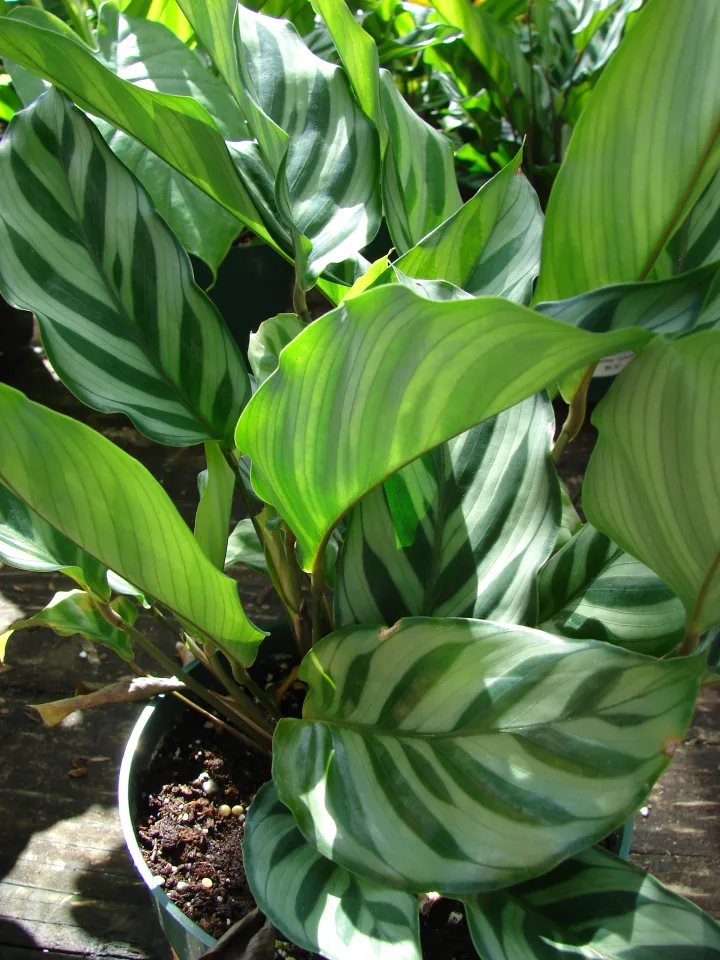
Photo : Forest & Kim Starr — CC BY 3.0 — source

🌱 Growing conditions
☀️ Light
Medium to bright indirect light.
💧 Watering
Keep lightly moist without saturation; low-mineral water is preferable.
🌡️ Temperature
18–27 °C
💦 Humidity
High
🪴 Potting mix
Humus-rich, light, airy and well-drained.
⭐ Difficulty
Moderate to demanding
🌱 Growth
Moderate
📏 Mature size
40–70 cm
🌿 Habit
Clumping
📝 About Freddie calathea
Description
A compact prayer-plant relative with elongated pale-green leaves marked by regular dark-green bands. The commonly sold “Freddie” form displays natural day-and-night leaf movement, which should not be mistaken for wilting.
Its foliage reacts quickly to water quality, dry air and abrupt changes in root moisture. Brown tips are therefore often an environmental signal rather than evidence of a serious disease. The plant expands as a clump from underground rhizomes and does not climb.
Care
Keep in medium to bright filtered light, away from hot sun and cold windows. Water as the surface begins to dry, preferably with low-mineral water. Keep humidity reasonably high while maintaining air movement.
Use rainwater, filtered water or another low-mineral water when tap water is hard. Keep the mix lightly moist but airy and avoid both prolonged drought and waterlogging. Higher humidity helps, but it should be combined with gentle air circulation rather than constantly wet foliage. Protect the plant from direct sun and cold draughts.
Repotting
Repot when rhizomes and roots fill the container, using a slightly larger pot and a mix that holds some moisture without becoming dense.
Repot when the clump has genuinely filled the container or the mix has compacted. Spring, as growth resumes, is a good time. Use a pot only slightly larger and a humus-rich but airy blend with drainage material and a little bark.
Propagation
Divide mature clumps and rhizomes, keeping several shoots per division.
Propagation is by division of the rhizomatous clump, not by a single detached leaf. Each division should retain several shoots, a piece of rhizome and healthy roots.
🐱 Toxicity
Generally considered non-toxic to cats and dogs.
🩺 Common problems
Yellow leaves
Too much water, cold conditions or damaged roots can cause widespread yellowing. One ageing outer leaf is not necessarily a problem.
Brown leaves
Dry air, mineral-rich water, irregular watering and direct sun are the usual causes of brown tips or edges.
Diseases
Root rot in waterlogged mix and leaf spotting when foliage stays wet for long periods.
Pests
Spider mites are the main pest; scale insects are possible. Check first for spider mites on leaf undersides, especially in dry air: fine stippling, dull foliage, then fine webbing. Scale insects tend to hide along petioles and veins.