Plant profile
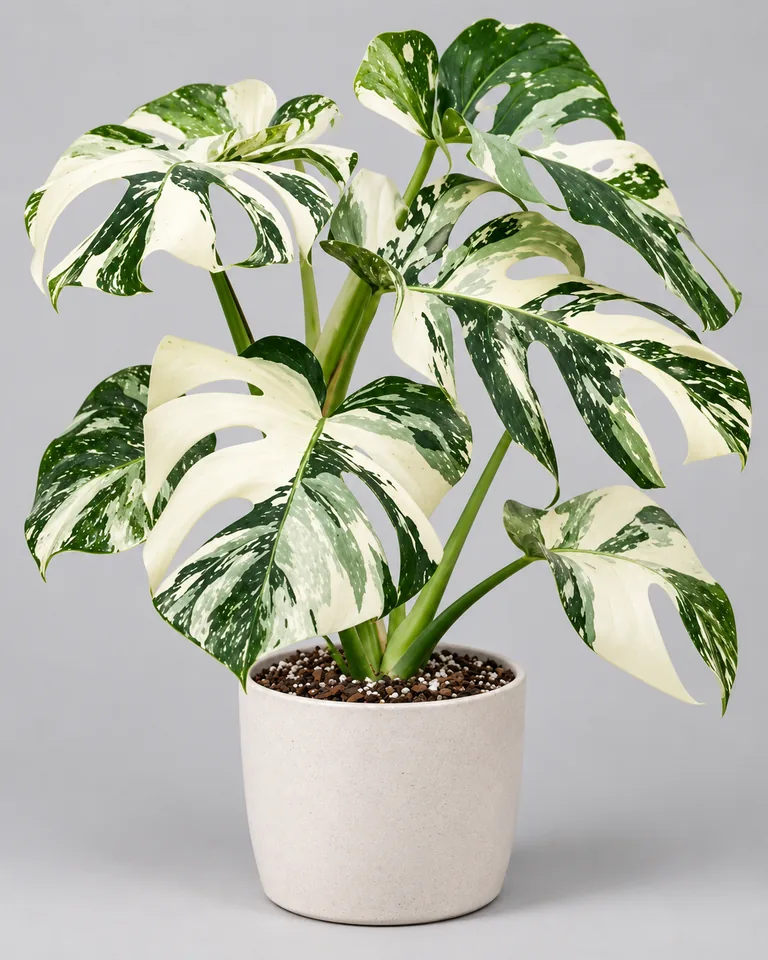
Monstera Albo Variegata
Monstera deliciosa 'Albo Variegata'
🌱 Growing conditions
☀️ Light
Bright indirect light; protect pale sectors from strong midday sun.
💧 Watering
Water when the top 3–5 cm are dry, then drain thoroughly.
🌡️ Temperature
18–28 °C; avoid prolonged temperatures below 16 °C.
💦 Humidity
Medium to high, ideally 50–70 %, with airflow.
🪴 Potting mix
Very airy aroid mix with bark, perlite or pumice and light organic matter.
⭐ Difficulty
Moderate
🌱 Growth
Moderate
📏 Mature size
1.5–3 m or more with support
🌿 Habit
Climbing
📝 About Monstera Albo Variegata
Description
Monstera 'Albo Variegata' is distinguished by its often sectoral white variegation. Some leaves show fine marbling, while others develop broad white areas that may cover half of the blade. The pattern is linked to the tissues within the stem and can change markedly from one node to the next.
That variability is part of the plant's appeal, but also part of its difficulty. A stem that is almost entirely green may start producing less-variegated leaves, whereas a stem with very little green tissue lacks chlorophyll and weakens more easily.
Like the standard Monstera deliciosa, it benefits from climbing. Strong indirect light and a good vertical support encourage larger leaves with mature fenestrations.
Care
Give it the brightest light possible without prolonged scorching sun. Pay particular attention to the white areas, which are more prone to drying and burning.
Water only after the mix has partially dried and always empty any water from the saucer. The roots need air; a constantly wet mix quickly increases the risk of rot.
Do not prune solely to obtain more white: the aim is to maintain a balance between green and variegated tissue. A vertical support also helps the plant produce larger, mature leaves.
Repotting
Repot when the roots are crowded, increasing the container size only slightly. Use a very airy mix containing bark, perlite or pumice, coconut fiber and light organic matter.
Avoid unnecessarily breaking large roots, and install the support during repotting if needed.
Propagation
Take a stem cutting containing a node and ideally an aerial root. A leaf on its own is not sufficient.
Observe the variegation on the node and stem: it gives an indication of the cutting's ability to produce new variegated shoots. Allow several roots to develop before moving it into a pot.
🐱 Toxicity
Toxic if ingested because the tissues contain irritating calcium oxalate crystals.
🩺 Common problems
Yellow leaves
General yellowing is often linked to overwatering, insufficient light or damaged roots. A single lower leaf may simply be aging naturally.
White sectors can yellow or brown faster without the whole leaf being unhealthy.
Brown leaves
Browning of the white areas is common. It can be worsened by dry air, direct sun, irregular watering or an excess of mineral salts.
Soft browning at the base of the petioles or roots is more concerning and should prompt a check for rot.
Diseases
Root rot and, less commonly, leaf spots in warm, humid conditions with poor ventilation.
Pests
Thrips, spider mites and scale insects; inspect newly emerging leaves particularly carefully while they are still rolled up.