Plant profile
Monstera Aurea
Monstera deliciosa 'Aurea'
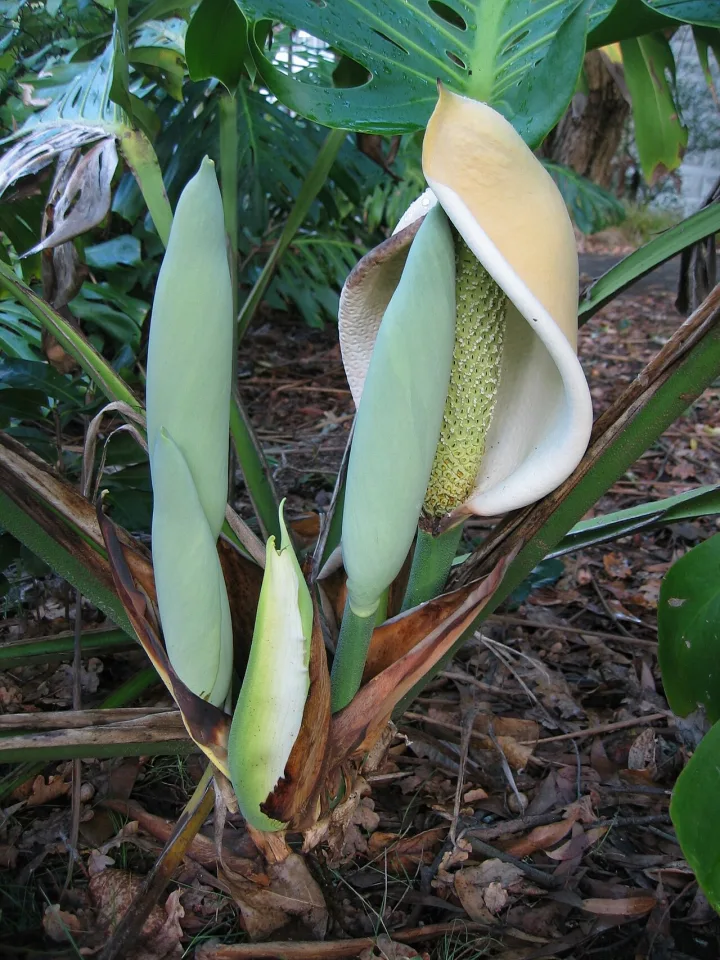
Photo : Avenue — CC BY-SA 3.0 — source

🌱 Growing conditions
☀️ Light
Bright indirect light; protect pale sectors from strong midday sun.
💧 Watering
Water when the top 3–5 cm are dry, then drain thoroughly.
🌡️ Temperature
18–28 °C; avoid prolonged temperatures below 16 °C.
💦 Humidity
Medium to high, ideally 50–70 %, with airflow.
🪴 Potting mix
Very airy aroid mix with bark, perlite or pumice and light organic matter.
⭐ Difficulty
Moderate
🌱 Growth
Moderate
📏 Mature size
2–3 m or more indoors with support
🌿 Habit
Climbing
📝 About Monstera Aurea
Description
Monstera deliciosa 'Aurea' is distinguished by yellow to yellow-green variegation that can appear as marbling, sectors or irregular patches. The contrast is usually warmer and less white than on 'Albo' forms.
The distribution of variegation depends on the tissues present in the stem, so two consecutive leaves may look very different. Yellow areas contain less chlorophyll and therefore slow the plant compared with an entirely green Monstera.
Like all Monstera deliciosa, it shows its full potential when allowed to climb. A vertical support, abundant filtered light and well-aerated roots encourage large, fenestrated leaves.
Care
Place it in a very bright position without harsh sun. The yellow variegation can scorch quickly behind a south-facing window if the plant has not been acclimated.
Water when the potting mix has dried at the surface and for a few centimeters below. A brief slight shortage of water is less dangerous than permanent saturation. Fertilize moderately during active growth.
Attach the stems to the support without compressing the nodes or aerial roots.
Repotting
Repot when the roots have colonized the pot, using a container only slightly wider. Use a coarse mix and install or reinforce the support at the same time.
Propagation
Take stem cuttings containing a node and a viable bud. Choose a section showing both green and yellow tissue; a piece that is almost entirely yellow has too little photosynthetic reserve.
🐱 Toxicity
Toxic if ingested because the tissues contain irritating calcium oxalate crystals.
🩺 Common problems
Yellow leaves
Distinguish normal yellow variegation from true yellowing. If the whole leaf becomes pale and soft while the potting mix remains wet, suspect overwatering.
Brown leaves
Yellow sectors are more sensitive to strong sun, drought, low humidity and mineral salts.
Diseases
Root rot, especially in compact potting mix or an oversized pot that stays wet.
Pests
Thrips, spider mites, scale insects and mealybugs. Inspect leaf undersides, nodes and young growth regularly. Silvery scarring, fine stippling, sticky honeydew or cottony clusters often reveal an infestation before it spreads.