Plant profile
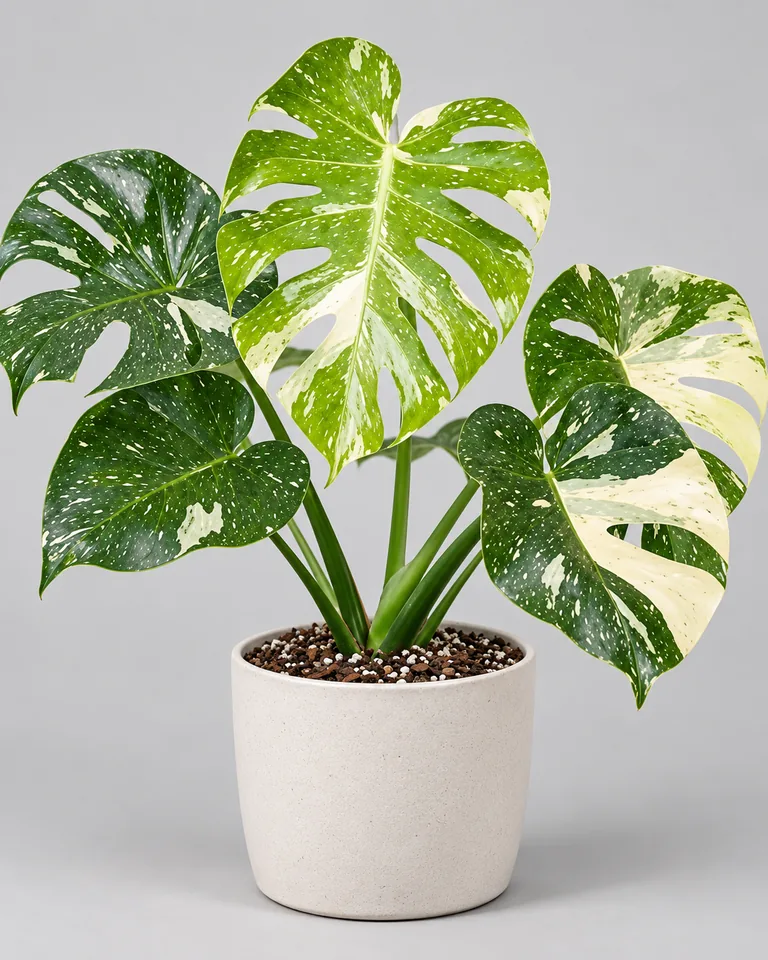
Monstera Thai Constellation
Monstera deliciosa 'Thai Constellation'
🌱 Growing conditions
☀️ Light
Bright indirect light; protect pale sectors from strong midday sun.
💧 Watering
Water when the top 3–5 cm are dry, then drain thoroughly.
🌡️ Temperature
18–28 °C; avoid prolonged temperatures below 16 °C.
💦 Humidity
Medium to high, ideally 50–70 %, with airflow.
🪴 Potting mix
Very airy aroid mix with bark, perlite or pumice and light organic matter.
⭐ Difficulty
Moderate
🌱 Growth
Moderate
📏 Mature size
1.5–3 m or more with support
🌿 Habit
Climbing
📝 About Monstera Thai Constellation
Description
Monstera 'Thai Constellation' is a stable variegated form of Monstera deliciosa, prized for the cream-colored splashes scattered across its leaves. Unlike some sectoral variegations, the pattern normally continues through new internodes, although the proportion of cream can vary considerably from one leaf to the next.
The plant keeps the climbing habit of Monstera deliciosa. With a vertical support and abundant filtered light, the leaves gradually become larger and develop deeper splits and fenestrations. The cream areas contain little or no chlorophyll, which explains why this cultivar usually grows more slowly than an entirely green Monstera.
A well-balanced plant carries enough green tissue to produce energy while still showing clear variegation. An almost white leaf can be spectacular, but it is also more vulnerable to direct sun, dehydration and browning.
Care
Place it near a very bright window, filtered by a sheer curtain if the sun is strong. Insufficient light greatly slows growth and can produce smaller leaves. Conversely, the cream-colored areas scorch more easily if the plant is moved abruptly into intense sun.
Water when the top layer of the potting mix has dried, thoroughly moistening the entire root ball and then allowing it to drain. The mix must remain airy: variegation is not a reason to keep the roots constantly wet.
Provide a stake, plank or moss support to encourage vertical growth and mature foliage. Fertilize moderately during active growth; excess salts can worsen browning on the pale areas.
Repotting
Repot during active growth when the roots are genuinely filling the pot. Move to a container only slightly larger so that a large volume of unused potting mix does not stay wet for too long.
Use repotting as an opportunity to install or reinforce the support. Handle the roots carefully and use a coarse aroid mix that can retain some moisture without becoming compacted.
Propagation
Stem cuttings are the reliable method. Every cutting must contain at least one node; a leaf without a node cannot produce a complete new plant.
Prefer a section of stem where variegation is visible in the tissue around the node. Root it in water, sphagnum moss or a very airy medium, then pot it up once several roots are well developed.
🐱 Toxicity
Toxic if ingested because the tissues contain irritating calcium oxalate crystals.
🩺 Common problems
Yellow leaves
Several yellow leaves while the potting mix is still wet often indicate overwatering or poorly aerated roots. One old lower leaf can yellow naturally.
If the leaves gradually become smaller and paler without becoming soft, also check the light level and the plant's nutritional status.
Brown leaves
The cream-colored areas brown more easily than the green parts. Common causes are overly strong sun, very dry air, irregular watering or salt buildup.
Dark brown, soft patches associated with wet potting mix point more toward a root problem.
Diseases
The main risk is root rot in dense or constantly wet potting mix. Bacterial or fungal leaf spots can also progress when the leaves remain wet without adequate air circulation.
Pests
Thrips, spider mites, mealybugs and scale insects. Thrips can damage young leaves before they have even unfurled.