Plant profile
Monstera pinnatipartita
Monstera pinnatipartita
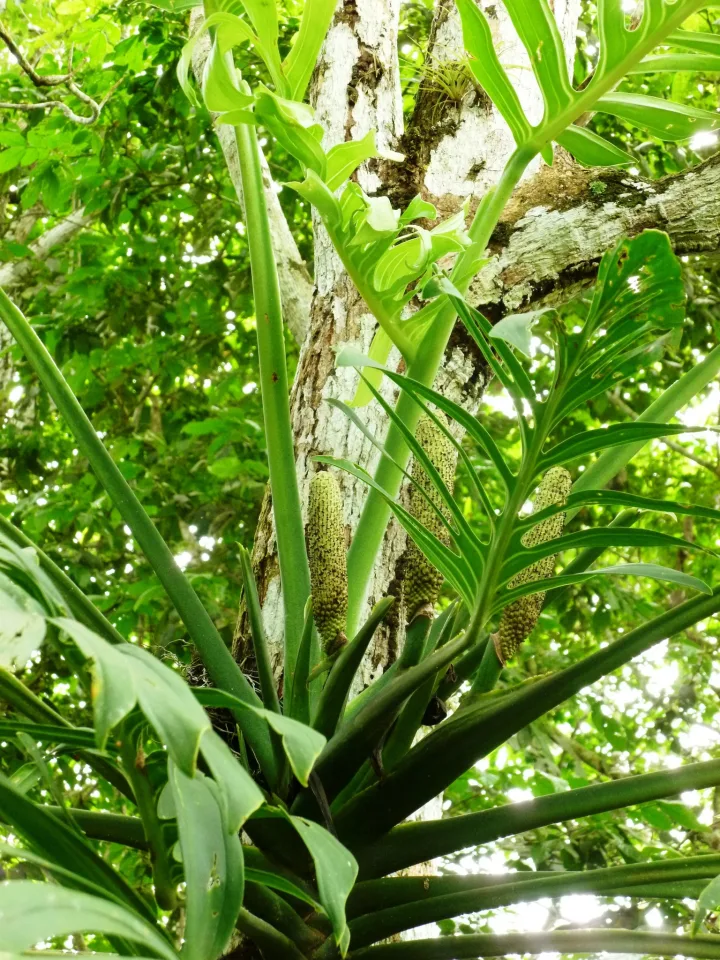
Photo : damonsalveo — CC BY 4.0 — source

🌱 Growing conditions
☀️ Light
Bright indirect light.
💧 Watering
Moderate: let the top few centimetres of the mix dry between waterings.
🌡️ Temperature
18–28 °C
💦 Humidity
Average to high
🪴 Potting mix
Rich, coarse and very free-draining, suitable for climbing aroids.
⭐ Difficulty
Moderate
🌱 Growth
Moderate to fast with warmth, light and support
📏 Mature size
2–4 m or more with support
🌿 Habit
Climbing
📝 About Monstera pinnatipartita
Description
A climbing aroid whose appearance changes strongly with age. Juvenile leaves are relatively entire, while mature leaves become deeply divided. Vertical growth on a support encourages larger, more mature foliage.
Its appearance changes markedly with maturity: young leaves remain relatively entire, whereas climbing adult growth develops increasingly deep divisions. Vertical support is therefore part of the cultivation method, not merely decoration. A plant left trailing often remains juvenile for longer.
Care
Provide a moss pole, board or other support and secure stems loosely. Give bright filtered light and water after the upper mix dries. A permanently wet mix slows root function and increases rot risk.
Tie the stem loosely to a board, pole or moss support and guide aerial roots toward the support or potting mix. Strong filtered light promotes shorter internodes and larger mature leaves; low light produces smaller leaves and longer gaps between nodes. Water after the upper layer has dried and never keep the mix permanently saturated.
Repotting
Repot during active growth when roots fill the pot. Use a container only slightly larger and a coarse aroid mix with bark, perlite or pumice. Upgrade the support at the same time if needed.
Repot during active growth when roots have genuinely filled the pot, using a coarse aroid mix of organic and mineral components. It is often practical to install or enlarge the support at the same time.
Propagation
Take stem cuttings with at least one node; a leaf without a node cannot make a new plant. Root in water, sphagnum or an airy mix.
Every cutting must contain at least one node; a detached leaf without a node cannot regenerate a complete plant. Cuttings can root in water, moss or a very airy mix, but should develop a useful root system before potting.
🐱 Toxicity
Toxic if eaten; tissues contain irritating calcium oxalate crystals.
🩺 Common problems
Yellow leaves
Overwatering and insufficient light are the two most common causes. If several leaves turn yellow while the root ball remains wet, check the roots.
One older lower leaf may yellow naturally without the plant being ill.
Brown leaves
Dry air, irregular watering or strong direct sun can brown the margins. Soft dark-brown areas point more toward root or moisture problems.
Diseases
Root rot in compact saturated mix; leaf spots can appear when foliage stays wet without air movement.
Pests
Thrips are particularly important on Monstera; scale insects and spider mites are also possible.