Plant profile
Furry feather calathea
Goeppertia rufibarba
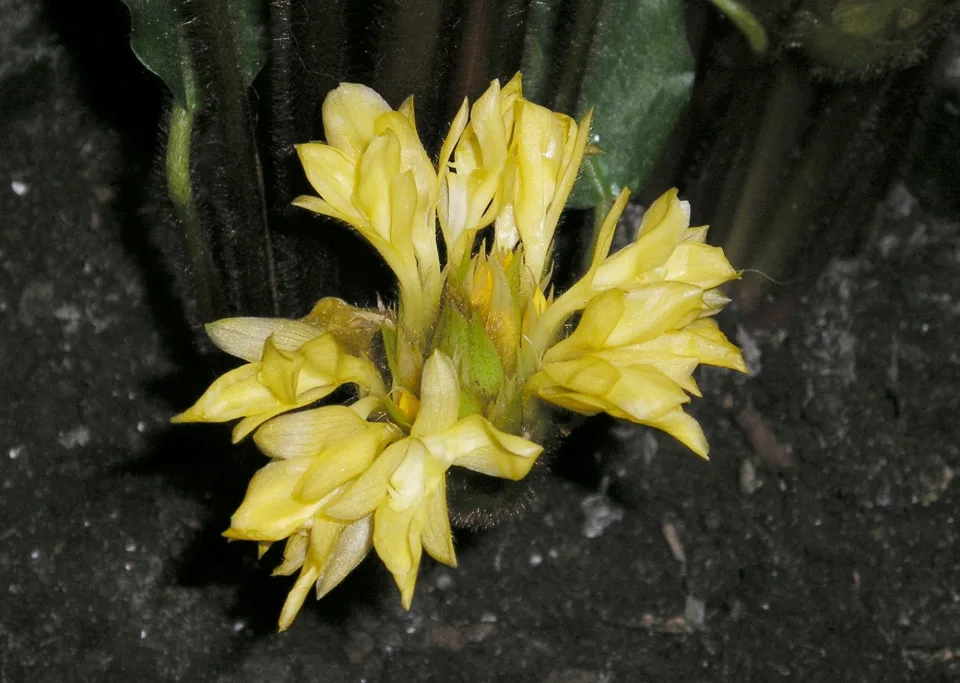
Photo : blumenbiene — CC BY 2.0 — source

🌱 Growing conditions
☀️ Light
Medium to bright light, always indirect.
💧 Watering
Keep the mix lightly moist without saturating it; soft or low-mineral water is preferable.
🌡️ Temperature
18–27 °C
💦 Humidity
High
🪴 Potting mix
Humus-rich, loose, airy and well-drained.
⭐ Difficulty
Moderate to demanding
🌱 Growth
Moderate
📏 Mature size
60–100 cm
🌿 Habit
Clumping
📝 About Furry feather calathea
Description
A Goeppertia with long wavy leaves, often purple beneath, and fine hairs on the petioles and lower leaf surface. It reacts quickly to hard water, very dry air and abrupt changes in soil moisture.
Its foliage reacts quickly to water quality, dry air and abrupt changes in root moisture. Brown tips are therefore often an environmental signal rather than evidence of a serious disease. The plant expands as a clump from underground rhizomes and does not climb.
Care
Provide medium to bright filtered light and protect from direct sun. Keep the mix evenly but lightly moist, preferably with rainwater, filtered water or another low-mineral source. High humidity is useful, but stagnant air should be avoided.
Use rainwater, filtered water or another low-mineral water when tap water is hard. Keep the mix lightly moist but airy and avoid both prolonged drought and waterlogging. Higher humidity helps, but it should be combined with gentle air circulation rather than constantly wet foliage. Protect the plant from direct sun and cold draughts.
Repotting
Repot when the clump fills the pot or the mix becomes compacted. Use a slightly larger container with drainage holes and a light humus-rich mix.
Repot when the clump has genuinely filled the container or the mix has compacted. Spring, as growth resumes, is a good time. Use a pot only slightly larger and a humus-rich but airy blend with drainage material and a little bark.
Propagation
Divide the clump during repotting, keeping several shoots, part of the rhizome and healthy roots with each section.
Propagation is by division of the rhizomatous clump, not by a single detached leaf. Each division should retain several shoots, a piece of rhizome and healthy roots.
🐱 Toxicity
Generally considered non-toxic to cats and dogs.
🩺 Common problems
Yellow leaves
General yellowing can follow excess water, cold roots or root stress. A single old outer leaf may simply be ageing.
If the mix stays wet for a very long time, check drainage and the condition of the roots.
Brown leaves
Brown tips are commonly caused by dry air, mineral-rich water or irregular watering; dry patches near a window can indicate direct sun.
Diseases
Root rot in waterlogged mix; leaf spots can spread when foliage stays wet in stagnant air.
Pests
Spider mites are the most common problem, especially in warm, dry air. Look for fine stippling, a dull appearance and small webs beneath the leaves. Scale insects can also occur.